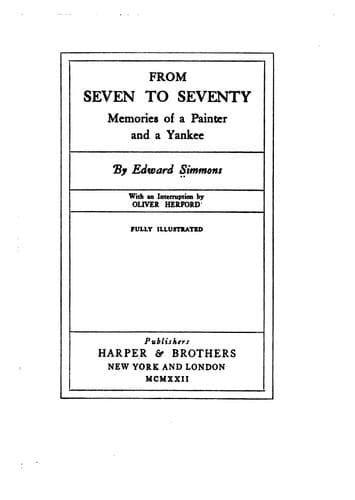
From Seven to Seventy: Memories of a Painter and a YankeeSimmons, Edward
General
From Seven to Seventy: Memories of a Painter and a Yankee
Simmons, Edward
Artists -- Biography
Duse is a direct contrast, at least to an outside observer, to Sarah. I
was walking in Union Square, approaching the place where Tiffany used to
be, when out of the door came a somewhat elegant, but modest-appearing
figure in black, moving swiftly toward a private carriage at the curb.
Something about her seemed familiar and I recognized Duse. Then I saw,
to my astonishment, that she was lame. She did not impress me at all on
the street, but on the stage she is the finest woman actor I have ever
seen. Just realize the physical handicap—you never see it behind the
footlights.
What a marvelous quality she gets out of that death-bed scene in
“Camille”—her simple nightgown, her expression while waiting for the
nurse to leave the room that she might reach under the bolster and get a
letter from “him,” the tragedy of her face as her fingers do not find
it, and the breaking of the sky after the storm. Her hand had touched
it! My respect rose for the great simplicity of this Italian actress.
Duse’s Armand throws everything at her when he begins to think she cares
for material things alone. I was telling this in The Players, when an
actor, since knighted by the British government, said when _he_ was
acting Armand, he threw the bag of gold at her. Imagine a “bag” of gold.
In my first days in Paris I saw the effects of the woman Dumas used for
the heroine of “Camille” sold at auction.
Duse seemed to me a failure in “Magda.” It had a northern humor that
required a Modjeska to sense. The second meeting with the former lover,
the country baron, which has always been such a tragedy to most
actresses, produced in Modjeska nothing but amusement and a sense of
irony. She had the most beautiful hands and arms I ever saw. I once sent
her a sonnet about them, and, although it was ten years later before I
met her, she remembered it, saying that I was the only man who had
discovered the secret of her appeal to her public. Even when she was old
and played “La Bataille des Dames,” her arms spoke to the audience and
expressed what she wished.
I have met few actresses and have been behind the scenes in the theater
only once or twice in my lifetime. Aside from paying my respects to that
superb raconteur, Madame Yvette Guilbert, painting a portrait of the
fascinating Nazimova, meeting Ellen Terry at tea, and being kissed by
the beautiful Maxine Elliott for saying she was a better actor than her
husband, I have come into personal contact with only one other—an
American.
Public-domain text, read in full here on John Shaqi.
Reviews
Reviews
No reviews yet
Be the first to share your thoughts on this work.
Elsewhere in the archive
Join the Discussion
Join the discussion
Sign in to leave a comment or review.
Sign InorCreate an account