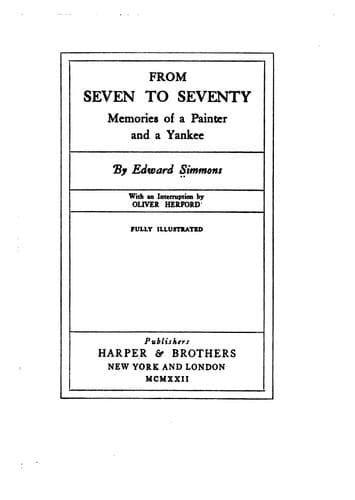
From Seven to Seventy: Memories of a Painter and a YankeeSimmons, Edward
General
From Seven to Seventy: Memories of a Painter and a Yankee
Simmons, Edward
Artists -- Biography
One rainy March day, while walking down Thirty-sixth Street when The
Lambs was in that delightful house that Stanford White built, a closed
carriage stopped between me and a Dutch stoop and a young woman got out.
She looked up in the air, annoyed, and was going to scuttle up the
steps, when I stepped forward to put my umbrella over her. I would have
done the same for a washerwoman. She took my arm like a thoroughbred,
and I saw her to her door. I had hardly gotten back to the walk when a
boy from The Lambs, opposite, came up, saying, “Some gentlemen in the
club wish to see you, sir.” I crossed over and went upstairs to confront
a line of men drawn up in martial order. There were twenty of them at
least, who saluted, chanting:
“We wish to congratulate you on your skill as a professional masher. You
are the first man who has succeeded in picking up Maude Adams.”
This was my first and only meeting with her, but she must represent a
type that I think beautiful, for one of the figures in a decoration that
I made entirely out of my head resembles her so much that I have been
asked many times if she did not pose for it. Miss Adams is one of the
women who have helped to bring the stage to that position among the arts
which men like Booth hoped it would reach.
Besides women, who always come first—who is it who says, “A man and his
wife are one, and she’s the one?”—The Players have entertained many
notable men, both local and foreign. I met Theodore Roosevelt there for
the first time. Not long after, I was in a Broadway car, when I saw him
hanging on to a strap. The talk turned to war. I had been back from
Europe only a short time and argued that America was not like England, a
cuttlefish with a vulnerable body needing long arms to get its food and
protect itself against its enemies; but rather like China, an oyster
covered by hard shell. The large navy necessary to the first was
superfluous to the second. I was met with a hurricane of abuse, to the
amusement of the whole car. I did not know that Roosevelt had just been
made Secretary of the Navy at Washington.
He told this story to us at the club. Two young Englishmen once turned
up at his office and he sent them out to visit at his home in Oyster
Bay. After some Saturday night festivities, when the women had all
retired from the table, one of the young men started to give his
impressions of America. He had been here two weeks.
“Mr. Roosevelt,” he said, “do you not feel that one arriving in a
foreign country is often shocked by things that the people living there
have gotten used to? Now we have been horrified by the American habit of
lynching. Cowardly, you’ll admit; subversive of all law and barbarous?”
“Oh yes,” said T. R., “that’s only natural. Now, for instance, I am
always shocked, when I land in England, at your habit of knocking down
your womenfolk and kicking them in the stomach. Subversive of all law,
cowardly you’ll admit—”
Public-domain text, read in full here on John Shaqi.
Reviews
Reviews
No reviews yet
Be the first to share your thoughts on this work.
Elsewhere in the archive
Join the Discussion
Join the discussion
Sign in to leave a comment or review.
Sign InorCreate an account