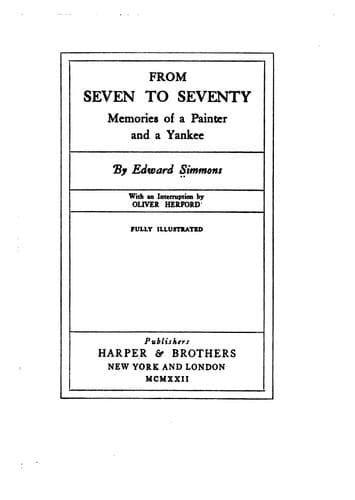
From Seven to Seventy: Memories of a Painter and a YankeeSimmons, Edward
General
From Seven to Seventy: Memories of a Painter and a Yankee
Simmons, Edward
Artists -- Biography
“Then,” said Mr. Booth, “Kellar performed some miracles that surpassed
all of those that had gone before. I asked him how he did them. ‘Mr.
Booth,’ he said, ‘I could show you with ease, but these are professional
secrets and my own personal property, the explanations of which I must
divulge to none!’ On reflection, I decided that my former belief in such
matters was harmful to my mind and I gave it up.”
I can understand, if I had the will power, giving up any physical habit
which I might feel was doing my body harm, but to have a mental disease,
realize it, and cure it, is to me almost inconceivable.
Booth was seemingly of a serene nature, but he was introspective, and
underneath that outward calm must have been a deep passion and sense of
his own being. He told me that he never stepped upon the stage for a
first night that his knees did not knock together horribly, but once
before the footlights, he forgot himself entirely. His sense of humor
was deep, and although he was always the quiet one of the group, he was
probably the most appreciative of a funny story or a witty remark. Even
when he lay in bed with his last illness his thoughts were upon these
things, for he was much disturbed because he could not remember the
point of a clever story he had heard.
For quite a while he had been failing. His legs had been giving out, so
that he used the little trunk elevator to go up to his room; then he
slowly grew feebler and feebler. I don’t doubt he suffered, but he never
let us know it, and his death was merely a gentle going away. I remember
the doctor coming downstairs and saying that he had just closed the eyes
of a man more than seventy years old. Mr. Booth had crowded into
fifty-nine years of life the experiences of an old man.
The Players is changed to-day. Of course, all old things must give way
to new; but there is a certain fine sentiment that remains. Perhaps the
young man does not appreciate the ideas upon which the club was founded
and the traditions which have kept it together, but something of the old
spirit is bound to be communicated to him on Pipe Nights or Founders’
Night, or on those occasions when old Joe Holland is brought up in his
big armchair. Then all gather around, a fire blazes in the great
fireplace, Mr. Booth’s eyes gaze down serenely from the wall above, and
each one vies with his neighbor in handing a drink or a smoke to Joe, or
telling him the latest story. Then will come in some wit or jester of
the gang, and jokes will be told that are as old as the hills, but ever
new. There is always a visitor or recent member to be delighted at the
old gag when Harry Dixey goes up to Joe and says:
“Lend me five dollars, Joe.”
“Go around to my good ear, Harry.”
With great ceremony, Harry will walk around.
“Lend me ten dollars, Joe.”
“Go back to my five-dollar ear, Harry.”
Chapter XIV: American Humor
Public-domain text, read in full here on John Shaqi.
Reviews
Reviews
No reviews yet
Be the first to share your thoughts on this work.
Elsewhere in the archive
Join the Discussion
Join the discussion
Sign in to leave a comment or review.
Sign InorCreate an account