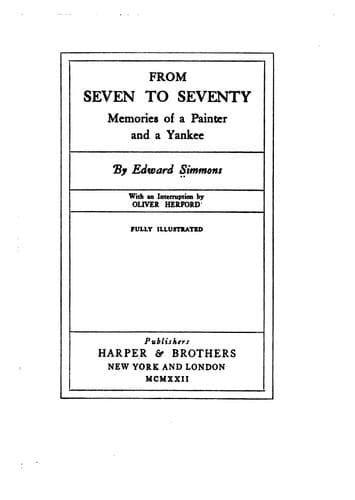
From Seven to Seventy: Memories of a Painter and a YankeeSimmons, Edward
General
From Seven to Seventy: Memories of a Painter and a Yankee
Simmons, Edward
Artists -- Biography
A humpback stood in front of Des Miriltons, a fashionable club of Paris.
Day and night his pathetic figure would be seen, a piteous expression on
his face, as he made his silent appeal to the men going into the
building—some to try their fortune at the gaming table. The French are a
superstitious race and have a thousand little ceremonies to lure the
great god Luck, one of the most efficacious being to rub the hump of an
_enfant d’escalier_—one born on a staircase. I have seen gold pieces
frequently change hands, as a member of this club rushed in or out, so
this particular deformity proved fortunate, for the humpback died
wealthy.
Now a hump, if it be a conspicuous infirmity, is never laughed at. One
is born with it and it is therefore not one’s fault. But deformities are
not all physical. I come of five generations of parsons who talked for a
living; also, at school, as I have said before, it was the habit of the
teacher to give credit to the boy who shouted his lessons the loudest.
This helped along the trouble, and I claim that talking too much is just
as much a mental hump as a twisted back is a physical one, and, as such,
should be pitied.
My brother used to say that any newcomer to the house where we lived
thought at first that everyone was suffering from some throat disease.
After a while however, he found that it was only hoarseness from talking
too much. I remember, as a boy, the sounds in the Old Manse. With mother
upstairs making beds, my sister halfway down, one aunt in the sitting
room, and another in the kitchen, there was a sort of continuous rattle
of words—never stopped, but only interrupted by the opening and shutting
of doors: “Lizzie, when you go downtown, don’t forget to buy—but she
won’t need—oh yes, I will if—it’s forty inches wide, and that—but
Sophie—well, red, if you—think blue will fade terr—in that case you’d
bet—two yards are—why not you see the sleeves will take—oh, let her
alone, she’ll get it all ri—”
There is a story of this disease of mine that Jules Guerin is fond of
telling. Of course, it never happened, but it makes a good tale. There
was to be a contest between the greatest talkers in the East and West. A
man from the Bohemian Club in San Francisco and myself were chosen.
There was money bet; we were put in a locked room with a loaf of bread
and a pitcher of water apiece. After three days the sounds of voices
died down and the anxious listeners broke open the door. The Western
talker was lying dead and I lay beside him, dying and _whispering_ in
his ear.
Sometimes this talk of mine has produced startling results. I had a dear
friend, now dead, whose son was connected with a monthly magazine. One
day I saw in it a botched attempt, as I thought, to tell, as his own, a
wonderful story of Anatole France’s. I was indignant and told everyone I
would make it my business to “call that young man down.” Some time
after, I was sitting at the writing table at The Players when the boy
came up to me, saying:
Public-domain text, read in full here on John Shaqi.
Reviews
Reviews
No reviews yet
Be the first to share your thoughts on this work.
Elsewhere in the archive
Join the Discussion
Join the discussion
Sign in to leave a comment or review.
Sign InorCreate an account