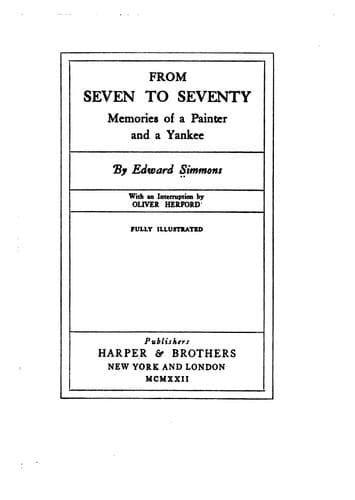
From Seven to Seventy: Memories of a Painter and a YankeeSimmons, Edward
General
From Seven to Seventy: Memories of a Painter and a Yankee
Simmons, Edward
Artists -- Biography
Stories of Oliver Herford come crowding to memory, topsy-turvy, one over
another, and although perhaps they should have no place here among
recollections of those long since passed away, his type of wit is mellow
when it is born and does not need time to soften its edge. Oliver is the
child of Whimsey; the eternal Puck or the Peter Pan; he has no age and
is of no age; like Topsy, I believe he just “growed.” His fun is full of
naïveté and childlike subterfuges; no task is too arduous for him if
there be a joke at the end; and he pokes that droll mind of his into the
oddest crooks and corners in the daintiest way.
I recall being with him in a restaurant when a man much the worse for
liquor approached our table and almost kissed him in his desire to be
friendly. Finally getting it into his drunken head that he was receiving
no response to his advances, he said.
“I don’t believe that you remember me, Mr. Herford.”
“I don’t recognize your face,” said Oliver, “but your manner is damn
familiar.”
I was in Oliver’s studio one day when a strange knock came at the
door—three long ones and two short raps. “S-h-h-h!” he said, and we both
kept quiet. After a sufficient time had elapsed for the person to have
departed, I asked him for an explanation. It seemed that —— was in the
habit of calling and boring Oliver terribly, so he told him that in the
future he intended opening the door only to his special friends, to whom
he would give a private knock.
It needs some uncommon quirk for a man’s mind to work in this fashion.
Instead of giving the private signal to his friends, he gave it to his
one particular aversion, so that he could recognize it instantly and get
rid of him quite neatly and without malice.
Another time, Oliver invited me to dine with him. We took a cab at the
door of The Players. On the way to the restaurant he went through his
pockets and found he hadn’t a cent. As I was broke myself, I decided we
were in a pickle. Not so Oliver. We alighted at the door of a prominent
café and Oliver approached the cabman:
“Say, dear fellow,” he began, and the driver, thinking he was going to
be held up for the fare, was disposed to be cross. But this was too
trifling a matter for Oliver to even mention.
“Say, dear fellow,” he continued, in his most confiding way, “I have
invited my friend here to dine and I find I have forgotten my money.
Could you—now I wonder if you could be a good chap and lend me ten
dollars?”
To my astonishment, the man, taken completely unawares, pulled out a
roll of bills and handed Oliver one of them.
One cannot be naïve by will power; the danger in consciously striving to
be childlike is that one becomes childish, and that is a very different
matter. I always think of Oliver Herford when I recall what Guy De
Maupassant said upon being challenged to make a new Beatitude—
“Thrice blessed are the naïve, for they shall never see _but_ God.”
Public-domain text, read in full here on John Shaqi.
Reviews
Reviews
No reviews yet
Be the first to share your thoughts on this work.
Elsewhere in the archive
Join the Discussion
Join the discussion
Sign in to leave a comment or review.
Sign InorCreate an account