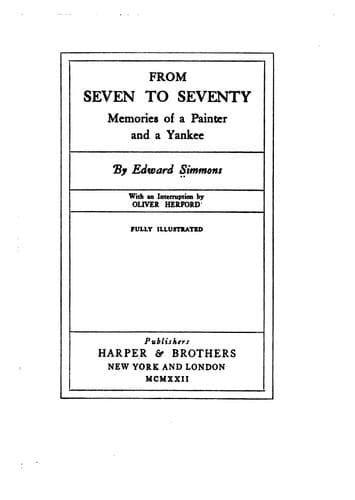
From Seven to Seventy: Memories of a Painter and a YankeeSimmons, Edward
General
From Seven to Seventy: Memories of a Painter and a Yankee
Simmons, Edward
Artists -- Biography
One of the brightest and most witty men I knew in the old days was the
actor, Maurice Barrymore, father of the present galaxy of stage folk of
that name. A beautiful body—I was told that he had been the amateur
champion middleweight of England—a face more Celtic than Saxon, Barry
was the originator of _bons mots_ that have gone all over the country. I
do not remember much about his acting, but I remember his delightful
companionship late at night (for he was a highly sensitive man who
burned the candle at both ends), his brilliant conversation, his great
intelligence and love of the fine things of life, his finesse, and his
swiftness of thinking.
Barry and I were sitting together one night at the Lambs’ Club when a
big fellow came up to our table and, hammering on it, said:
“Maurice Barrymore, you are a —— —— liar!”
“Oh no,” said Barry, quietly, “not if _you_ say so.”
Once at the old Fifth Avenue Hotel he was taking a drink with some
friends, when he heard a voice mumbling behind him something about a
blankety, blank actor. He immediately turned and told the man to shut
up, adding a well-known phrase which indicated that he was the son, on
his maternal side, of a domestic animal we all know. The man rose and
came forward, swinging his arms and shouting wildly:
“You call me that? By God! I wish I had you in Louisville! You wouldn’t
dare to call me that in Louisville!”
Barry knew that he was not really dangerous, and, besides, he was afraid
of no one, so he calmly walked up to the stranger and, putting his arm
affectionately about him, said:
“Oh, if your mother’s reputation is a question of geography, come and
have a drink.”
The extreme delicacy of Barry was shown in many ways—chiefly in his
kindness to any young actor who was trying to get ahead. He was not the
type to help by a lot of talk, but by little attentions quietly shown.
When he was playing Rawdon Crawley with Mrs. Fiske in “Becky Sharp,”
there was a young countryman of his, newly come over from England, who
had the part of Dobbin. Barry was notoriously careless of his appearance
on the stage, but in this case he groomed himself to the eyes just to
give the younger man a chance to shine by contrast. He was perfectly
willing to be what in vaudeville parlance is called a “feeder,” if it
were for the good of the play or anyone in it.
Englishmen sometimes twitted Barry for his love of America, and he often
had to stand quips from us about his British parentage. An American once
stuck a coin in his eye and, in a leering manner, walked up to Barry,
singing that famous song of Henry Dixey’s called, “It’s English, You
Know.” Thinking to add a little flavor and more insult, the man made a
vulgar remark. Barry turned to him quietly and said:
“No, it is not the English I know.”
Once a crowd of English actors started to have some fun with Barry about
his long residence in America and his American marriage. Then they
started on the American language.
Public-domain text, read in full here on John Shaqi.
Reviews
Reviews
No reviews yet
Be the first to share your thoughts on this work.
Elsewhere in the archive
Join the Discussion
Join the discussion
Sign in to leave a comment or review.
Sign InorCreate an account