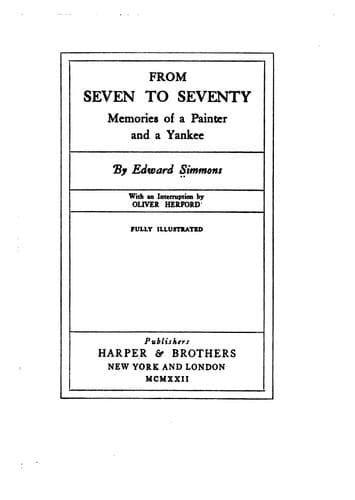
From Seven to Seventy: Memories of a Painter and a YankeeSimmons, Edward
General
From Seven to Seventy: Memories of a Painter and a Yankee
Simmons, Edward
Artists -- Biography
“Why you see the way they spell over here,” they cried. “Good old
_humour_ and _honour_ have become _humor_ and _honor_.”
“Yes,” said Barry. “You see, they don’t think they have to come to you
for either one of these qualities, so in such matters they leave “u”
out.
Speaking of “humor,” I like to think of Anatole France’s brilliant
illumination of the word, which, paraphrased, runs something like this:
“The Angel of Humor is sent us that she may teach us to laugh at the
wicked and foolish, whom, without her aid, we might have the weakness to
hate.” In my reading of funny stories, the really good ones have an
element of sadness; also I have watched the development of the faces of
the humorists I have known. As they grow older the lines of mirth are
sure to be backed by signs of very deep feeling. Humor is distinct from
wit (which is the joyousness of childhood) and comes after suffering,
proving a man to have graduated from the cave-dweller class. Savages are
bitter and yell when hurt, but a gentleman keeps quiet. Humor, to me, is
the cry of a well-bred man in pain.
When we New Englanders tell stories of ourselves and our forbears, they
are generally based fundamentally on the hard lives, or the
characteristic qualities that resulted from the hard lives, which those
first settlers on the coast of the Atlantic were forced to lead. Their
sense of humor conceals an infinitude of suffering, as does that of the
men who live in the hills of Kentucky. Professor Shaler of Harvard told
me that he had found them very much alike in their laconicism and
understatement—two parents of humor.
To illustrate what I mean—my mother’s sewing woman in Concord, the
dried-up individual who made my breeches, always with a mouthful of
pins—was asked by the neighbors when her mother died:
“Was she willin’ to go?”
“Willin’! My dear, she was obleeged.”
“Did she leave anythin’?”
“Yes, she left everythin’. Didn’t take nothin’ with her.”
A story which gives a picture of the drudgery so great that they were
always careful to save themselves the smallest extra task is of the old
farmer sitting with his wife beside the kitchen table in the evening. A
newspaper is in his hand, a kerosene lamp illuminates the room, and his
feet, incased in woolen stockings, are in the cooling oven. The
grandfather’s clock strikes nine.
“Time to go to bed, Maria.”
“Yes, Eben.”
She precedes him with the lamp, and he follows with his shoes in his
hand. At the foot of the staircase he stops and says:
“Did you wipe the sink, Maria?”
“Why, of course!”
They proceed. When she is at the top and he is half way up, she leans
over the balustrade, saying:
“What made you ask me that, Eben?”
“Well, I _did_ feel as if I’d like a drink of water, but if you’ve wiped
the sink I guess I’ll put it off till to-morrer.”
There are many stories of the Yankee thrift, but one very old one is
hard to beat. A farmer, in the days when a grocer also kept a bar,
drives up to the country store and says:
Public-domain text, read in full here on John Shaqi.
Reviews
Reviews
No reviews yet
Be the first to share your thoughts on this work.
Elsewhere in the archive
Join the Discussion
Join the discussion
Sign in to leave a comment or review.
Sign InorCreate an account