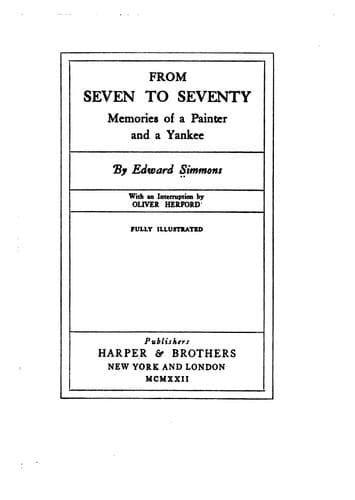
From Seven to Seventy: Memories of a Painter and a YankeeSimmons, Edward
General
From Seven to Seventy: Memories of a Painter and a Yankee
Simmons, Edward
Artists -- Biography
I had hoped to stay in California; every one dreams of dying there, I
suppose, but I found it would be impossible to make a living. They will
not purchase anything that has not already been hallmarked by New York
or European approval. Then, too, the climate produces a strange effect
upon the Eastern temperament. I saw an apple tree with fruit larger and
different from any I had ever eaten. The farmer assured me, upon his
word of honor, that he had brought it from New England as a young tree
and that it had been a true Eastern russet.
[Illustration:
EDWARD SIMMONS
At the age of seventy
]
After my return to New York I carried out two ceilings for Mr.
Rockefeller, which were placed in the tea houses at the entrance to his
Tarrytown home; I made a decoration for a lumber man down in
Mississippi, and then came the War. I was too old to go; they even
refused me in the Camouflage section, although I insist I would have
been of use.
Although I was not allowed to take part in the War, my whole world
changed. The color of everything—we were enmeshed in khaki. To eyes
accustomed to riotous shades, this deadening of the whole tone of things
was tremendously depressing. And then the strides—machine guns, tanks,
bombs, poison gas, everything came tumbling and tossing, one over the
other, in a mad strife for something to end it all. But all the time
they were only getting farther involved. I wanted to keep step, and felt
as if I were marching, marching, marching—until I would suddenly become
conscious that I was only sitting still. I had never found the necessity
of realizing the meaning of the old saying, “He also serves ——.” For the
first time I was forced to acknowledge that it was the age of the young.
I saw a picture of myself as the perfect Uncle Sam, his long legs stiff,
his gray hair flying in the wind, his coat tails standing out farther
than they had ever done, struggling to keep his footing; while all about
him, over him, and under him were a mass of young men and boys in
uniforms of tan, bearing the modern equipment of war and heeding not at
all this old-fashioned figure who was gradually being left behind.
Chapter XVI: In Retrospect
I once started a sonnet to “My Soul,” but, having written one line, I
found that I had said all—
Cross-hatched with many a shameful scar.
It is doubtful if I have a soul, but if so, I am sure that if it shows
scars of victory, they are the results of battles that should not have
been fought.
We have never been a religious family, as I look back. The future? For
me it is here. My mother understood. Think of the agony of a woman who
had never had a hand laid upon her since she was a child, lying
completely helpless, paralyzed for six years! The last time I saw her, I
said:
“Mother, you and I know what we believe about a future life?”
She nodded feebly.
“You are unhappy here?”
Public-domain text, read in full here on John Shaqi.
Reviews
Reviews
No reviews yet
Be the first to share your thoughts on this work.
Elsewhere in the archive
Join the Discussion
Join the discussion
Sign in to leave a comment or review.
Sign InorCreate an account