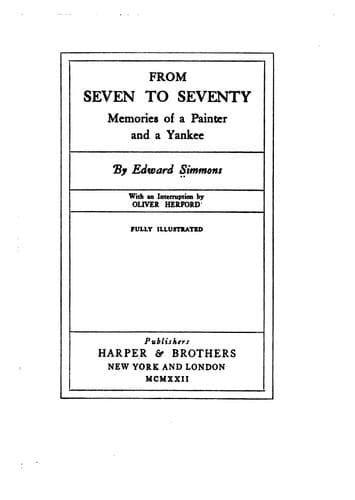
From Seven to Seventy: Memories of a Painter and a YankeeSimmons, Edward
General
From Seven to Seventy: Memories of a Painter and a Yankee
Simmons, Edward
Artists -- Biography
Again the nod, with a pathetic look in her eyes. I leaned over and
whispered in her ear.
“Mother, I hope you die to-night.”
No one knew of our conversation, but I was told afterward that she wrote
on her slate that evening, “Edward has cheered me up greatly.”
I see that I have always felt this way and have tried to live the
fullest life possible. When I think of the progress of mankind during my
seventy years—from lamps to electricity, from horses to gasoline, from
slow mails to wireless, and the aeroplane bringing the other continent
as near to us to-day as the next town was in my boyhood—I marvel at
those who say that the world is going backward.
The advance of one human being is comparable to the advance of the whole
race—it is the resultant force of a spiral spring. At the bottom of the
coil is Realism; at the top, Idealism and, although we are a long time
in getting around the circle, the progress is as certain as the air we
breathe.
All these changes should make me feel old, but they don’t. Like Barton
Hill, who went to call upon an old friend and mistaking the daughter
(who came to greet him) for her mother, said:
“Now I solve the wondrous question,
Now I find what I did lack.
You’ve stolen some years from your mother
And forgot to give them back.”
I do not wish to belong to my own generation. “Whom the gods love, die
young” does not mean that they die when they _are_ young, but that they
are _young_ when they die, and I could not ask anything finer from a
generous Creator.
I have been happy from the time I was born. It may be that time covers
with an ivy of forgetfulness the early wounds and renders them less
hideous, but I do not think so in my own case. I am a lover; I am happy
because I love all things. I feel like our Irish cook who brought in a
fish from the river, cooked it, and proceeded to consume it all,
clutching it at the tail and eating all the way up, saying,
“It’s all very swate; it’s all very swate.”
Since a boy, I have been able to take an interest in the crack in a
granite stone and wonder “why”; in the lichen that grows upon it, and
“why”; in the blackberry bushes around it, and “why”; in the earth
underneath through its change into sand; in the weather and in the life
of all the little things. After death, to furnish the manure for all
these is enough of a future life for me.
Meanwhile, there is still beauty in the curve of a wave or a woman’s
breast, there is liberty and there are friends. But best of all there is
hope. I am still an optimist.
THE END
------------------------------------------------------------------------
TRANSCRIBER’S NOTES
Public-domain text, read in full here on John Shaqi.
Reviews
Reviews
No reviews yet
Be the first to share your thoughts on this work.
Elsewhere in the archive
Join the Discussion
Join the discussion
Sign in to leave a comment or review.
Sign InorCreate an account