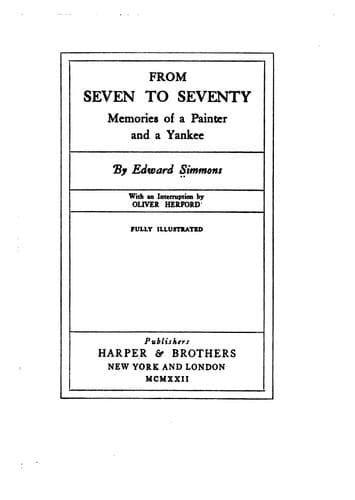
From Seven to Seventy: Memories of a Painter and a YankeeSimmons, Edward
General
From Seven to Seventy: Memories of a Painter and a Yankee
Simmons, Edward
Artists -- Biography
I found that my business career did not interfere in any way with my
social life in Cincinnati. I was still anxious to be an artist and was
painting in my bedroom every night. The city was, even at that time,
beginning to be an art center for the Middle West. Nicholas Longworth,
grandfather of the husband of Miss Alice Roosevelt, had shown a
particular aptitude for making money and a better one for spending it
the right way. As a young man he had climbed the hills of the town and,
looking from them across the water, decided it would be impossible for
the city to extend in but one way. Accordingly, he put his savings into
land, always keeping one lap ahead of the spread of population. Caring
for beautiful things, he began to encourage the fine arts, and it was at
his home that I saw my very first collection of oil paintings. Concord
was the home of the steel engraving, and the copies of oils that my
father had brought back with him from Europe and hung up in the Old
Manse swore at everything else in the house. The Longworth collection
was mostly German pictures—by Koeck-Koeck, Meyer von Bremen, and two by
Lessing of the life of Huss, the martyr, which were evidently worthless,
but so aroused my decorative instinct that I remembered them for years
after.
Wandering up the main street of Cincinnati one evening, I saw a name
plate on a doorway—one I had never heard—and after it the magic word
“Artist.” I was thrilled. There was actually some one in this town
living and having his being and spending his time painting. I used to
pass back and forth before this sign, which was at the bottom of a
stairway, like a dentist’s or a photographer’s; and finally, one evening
just at dusk, I got the courage to go up. Knocking timidly on the door,
I was greeted with loud roars of “Come in.” The dingy room was a holy of
holies to me—I had never seen an artist’s studio before. In the far
corner was a man in a khaki apron, using the blackest of soft soap to
wash what were, in my eyes, enormous brushes. Heretofore, my own
experiments in oil painting had been made with the usual small brushes
and a tin box used by maiden ladies. The bigness and boldness of this
establishment took my breath away.
When I got the courage to look about I saw that, besides this big Norse
viking with the tumbled hair, there was a sculptor in the corner,
modeling—think of the daring!—a figure in the nude! I must have
presented a ridiculous figure, for there was a laugh behind my back,
and, turning, I saw a woman almost naked, sitting on a stool! They asked
me why I had wanted to come in, and I told them I tried to paint, but
that I had never seen a studio before. I looked with wonder at the big
canvases on the wall, and even then realized that here was a sense of
color altogether different from that of the German artists, and that the
capacity for brushwork was a marvel—for this painter was none other than
Frank Duveneck, who had just returned from Munich.
Public-domain text, read in full here on John Shaqi.
Reviews
Reviews
No reviews yet
Be the first to share your thoughts on this work.
Join the Discussion
Join the discussion
Sign in to leave a comment or review.
Sign InorCreate an account