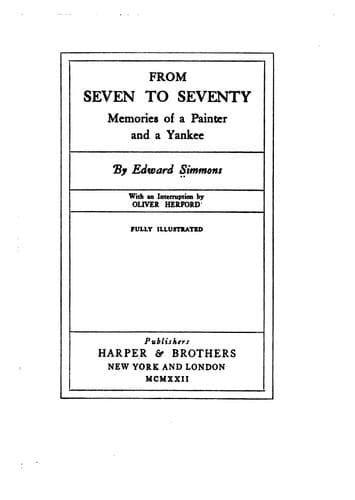
From Seven to Seventy: Memories of a Painter and a YankeeSimmons, Edward
General
From Seven to Seventy: Memories of a Painter and a Yankee
Simmons, Edward
Artists -- Biography
“Bub had most likely bin diggin’ under the rock and gitting out the pay
dirt, and when he’d git so fur in he’d put in a plug to shore up the
thing and keep it from fallin’. That day when he read that paper and he
felt the whole world crumblin’ ’round his head, he jest made it literal
by goin’ up to his claim, crawlin’ under the stone, and kickin’ out the
plugs.”
There was a pause.
Peter rose; cutting a piece of the roasting brisket, he started for his
bunk, but stopped before climbing in.
“That’s why I ast you if you turned over the stone—but I hoped you
didn’t.”
Scott had been fifteen years in the woods and wanted to settle down,
saying he would like to see some little Scotts running around. So when
the summer camp broke up he looked about for a location. He found a log
house that had been built by a man named Carrick, who was hated in the
community, principally because he held mortgages on nearly all the farms
for twenty miles around. Carrick did not have a right to this particular
homestead, as he did not live on it, so Scott went in and jumped the
property.
Knowing Carrick would try to use the land, Scott was ready for him, and
when he tried to put his sheep in, Scott, who was waiting in a hole in
the ground, rose with his gun in his hands, saying:
“_Don’t touch them bars!_”
Like all crooks, Carrick was a coward at heart, and, instead of settling
in the usual way of this part of the country—as man to man—he took Scott
into court. With no money in back of him, Scott won his case, his
extreme honesty and simplicity impressing the judge. For instance, I
remember there was a question as to whether he was an American citizen
or no, and he answered:
“Wal, Jedge, the first thing I remember is livin’ in a town about a half
a mile over the border into Canada, but my mother allus said I was born
in a little red house that we could see across the line, an’ I took her
word for it.”
And so did the court.
I had left Scott and Peter Klink and had gone back to Sissons, when one
morning a man we called “the Texan” came racing down the town’s one
street on horseback, yelling:
“Scott’s shot! Scott’s shot!”
Scott had been beloved of all, and everyone was aroused. It was quite
awhile before we could get the story out of the Texan, but it finally
came to this. He had come across a wagon standing all alone on the road,
filled with the groceries Scott had bought in Yreka. It was turned
around, with the horses facing downhill, the whole weight of the wagon
bearing upon them. They were nosing toward home and evidently had been
there all night, as they were covered with snow. Looking about, the
Texan had seen a trail into the bushes and, going in a half mile or
more, he found Scott’s body. There was a rope around the neck and he had
been dragged into the woods.
The memory came to me of one night when I was camping with Scott. The
conversation had turned on death.
“How would you like to die?” I asked him.
Public-domain text, read in full here on John Shaqi.
Reviews
Reviews
No reviews yet
Be the first to share your thoughts on this work.
Elsewhere in the archive
Join the Discussion
Join the discussion
Sign in to leave a comment or review.
Sign InorCreate an account