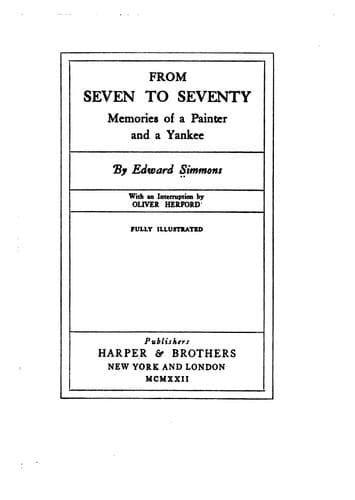
From Seven to Seventy: Memories of a Painter and a YankeeSimmons, Edward
General
From Seven to Seventy: Memories of a Painter and a Yankee
Simmons, Edward
Artists -- Biography
“Shot in the back and never know who done it,” was his quick answer.
Scott had had his wish.
Death meant nothing to these men. It was all in the day’s happenings,
but to me, at this very moment of writing, visualization of Scott’s
body, as it lay on the rough pine bed in a back room in Sisson’s Hotel,
is as clear as it was in 1877. The rope had been taken from his neck and
had left an impress, above which rose his purple head, looking like an
eggplant, with the shock of red hair, the pale blue eyes wide open, and
the rows of perfect teeth showing, his mouth drawn into a snarl. His
body was green-white, the blood having all gone to the head, and under
the left arm, where the bullet had gone in, was a little blue spot. But
under the right arm, where the bullet had come out, was a ghastly hole
through which protruded torn pieces of flesh. I did not know that men
died that way.
A few minutes after the body was brought in a woodsman was found who had
passed the wagon—it must have been while the murderer was disposing of
the body in the bushes—for he said that a Ballard rifle was leaning
against the wheels. He had thought the driver of the wagon was off in
the woods and would be back presently, so was in no way surprised at the
sight.
The minute the woodsman mentioned the gun I was convinced as to who had
committed the murder. I had seen Carrick’s Indian with a Ballard rifle.
It had a broken extractor, and he had to use a withe to poke out the
empty shell. Sure enough, beside the road we found a withe covered with
powder. An Indian tracker told us, from his examination of the trees,
that the murderer had worn a red tippet and was riding a sorrel horse
with a white star. The evidence was conclusive enough for us to start
out for Carrick’s ranch.
We were a posse of four—the Texan, who had been in the Civil War and was
a real leader; Joe Johnston, a friend of Scott’s; one of Joe’s hired
men; and myself. We were prepared for a fight, for, as Carrick hated
Scott and was probably implicated in the affair, we figured he would
protect the Indian.
The way lay over fertile, grassy country, and on the road we passed
bands of sheep and cattle. One herder rode several miles with us and, on
hearing our errand, said:
“If you help me git these cattle together I’ll tell you something I
know.”
It seems that the night before he had been at Carrick’s house. It was
getting quite late when he heard a mysterious whistle under the window.
Making an excuse, he went outside and looked about. There in the corral
was a horse—sorrel in color with a white star on its forehead—evidently
just returned from a hard run, as it was covered with lather. At that
moment he heard a sound, and coming out of the kitchen door was
Carrick’s son, carrying something in his hand. He disappeared into the
barn. Creeping up to a crack in the building where a light shone out, he
peeped through and saw the boy giving food to an Indian.
Our evidence was piling up.
Public-domain text, read in full here on John Shaqi.
Reviews
Reviews
No reviews yet
Be the first to share your thoughts on this work.
Elsewhere in the archive
Join the Discussion
Join the discussion
Sign in to leave a comment or review.
Sign InorCreate an account