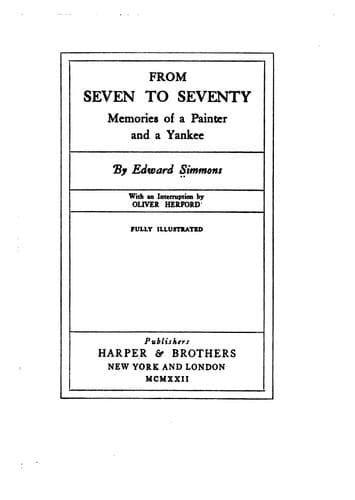
From Seven to Seventy: Memories of a Painter and a YankeeSimmons, Edward
General
From Seven to Seventy: Memories of a Painter and a Yankee
Simmons, Edward
Artists -- Biography
Along toward sunset we rode up to Carrick’s place. The sheep ranch
extended for many acres to the north, while the house, barn, and corral
were on the banks of a low willow creek. Carrick was sitting on a bench
out in front. Going directly up to him, the Texan said:
“Scott’s bin killed—shot.”
“The hell you say!”
“We think your Injin Jim done it.”
He pretended great anger.
“Well, if he did, ketch him and string him up for it. He’ll be back in a
little while.”
We waited.
It was not long until several horsemen appeared and rode up to the gate.
Joe Johnston’s hired man, who was a fool and easily excited, marched up
to Injin Jim and said:
“We’re here to arrest you.”
I have seen a prestidigitator work the most astonishing disappearances
of material things, but I never saw a human being take himself off into
space as quickly as this one did. Jim gave one flick and was flying into
the woods. I was off and under my horse in an instant, but my pistol
missed fire. He had disappeared into the willow creek, which was
overgrown with grass, with here and there patches of water covering
treacherous quicksand. Our only hope was to close round him and ride him
out.
I was in a bad way. My horse had poll evil, and my pistol would not
shoot without the use of an oaken plug. I had seen Jim kill rabbits on
the run many a time, and, adding this to my grief at my friend Scott’s
death, I was working up a great case of true tenderfoot fright. I was so
scared that I would not have recognized Jim if I had seen him, but I
kept on. Finally, the Texan saw that I was rattled and stopped and drew
me behind the others. To think of anyone noticing my condition drew the
tears of mortification to my eyes.
“Go up the hill,” he said, handing me a Winchester, “and watch and see
that Jim does not leave the valley.”
This was a diversion, and I was certainly glad to get away from the
others. I must have stayed up there several hours, and all the time the
hunt was going on there was an accompaniment of wails from women and
children of the Indian camp near by. They would moan and cry to an even
rhythm, and then all of a sudden there would be a pause. The silence was
extraordinary.
At last the Texan called me to come down from my vantage point. Jim had
sent a deputation of squaws to say that he would give himself up if we
would promise not to lynch him. An Indian is afraid of hanging only
because he believes—as the Greeks did—in the Animus. The breath is the
soul, and he will never get to the happy hunting grounds if he is killed
by cutting it off.
We accepted his surrender and began the journey to Johnston’s. Jim’s
legs were tied under his horse, and I can see the procession now, the
Western sun hitting them as they rode on ahead of me. The smell of
sweat, saddle leather, and alkali comes back to me as pungent as if it
were yesterday. The two Carricks seemed to be loath to leave us, and the
old man kept crying repeatedly:
Public-domain text, read in full here on John Shaqi.
Reviews
Reviews
No reviews yet
Be the first to share your thoughts on this work.
Elsewhere in the archive
Join the Discussion
Join the discussion
Sign in to leave a comment or review.
Sign InorCreate an account