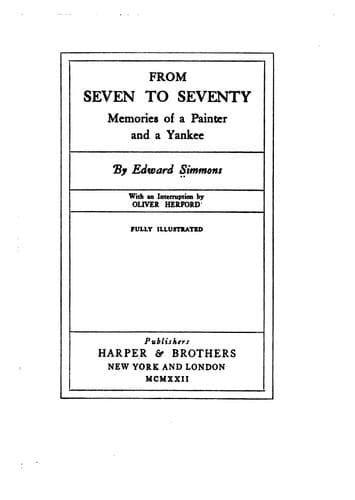
From Seven to Seventy: Memories of a Painter and a YankeeSimmons, Edward
General
From Seven to Seventy: Memories of a Painter and a Yankee
Simmons, Edward
Artists -- Biography
When the calm was restored it was seen that his action had had the
desired affect, for several arms were broken and one or two Frenchmen
were completely knocked out; but for an exhibition of true heroism and
Americanism, it was gorgeous.
A great event was the Bal Bullier—the students’ ball; everyone went, and
it was “artist” all through. Things always went well unless some one
broke one of the unwritten laws. For instance, all the women who
amounted to anything wore masks, and to take them off was an invitation
to everyone. One evening at one of these affairs I suddenly heard:
“Any Americans here?”
In the middle of the floor, surrounded by dozens of Frenchmen and
fighting with his fists, was an upstanding male in a cowboy hat—a
fashion then unknown in Paris. Some one had broken the rule and taken
his girl away from him. In a flash I recognized him as Charley White, a
man I had known in the north of California.
I looked about me and yelled to each corner of the room:
“_À moi, Julian! À moi, Julian!_”
Instantly dozens of men sprang from all sides with cries of:
“_À toi, Simmons! À toi, Simmons!_”
In a second they were upon their brother Frenchmen, had downed them, and
had hustled Charley White out of the room. No matter where one is in
France, he can always call his class to his side; architects stick to
architects, actors to actors, painters to painters, and so on. I could
never convince my friend, however, that I did not employ private police.
These nights of revelry were few and far between; our evenings were
spent in the studio, and I always see them in “black and white.” Black
were the shadows in the recesses not reached by the big gas flame, black
were the heads of the Europeans, strange beings to me at that time, some
of them with beards; while the body of the model, the straining faces of
the students, and the paper on the easels before us were a gleaming,
glaring white. We did drawing alone at night.
Up to this time there had been one and only one real influence upon my
artistic life, and that was Doctor Rimmer. While at the Boston Art
Museum I used to go over to the Institute of Technology to his classes
in art anatomy. Dr. William Rimmer, who is only to-day being given any
recognition, probably occupies in the artistic world somewhat the same
position that Samuel Butler does in the literary world. Rimmer’s work is
being dragged out of obscurity to-day by men like Gutzon Borglum, as
Butler’s was by Bernard Shaw.
He was a large man with a foreign accent, a crank, but an enthusiast and
very excitable. His absorption in his work was that of a crazy genius,
but his knowledge of the structure of the human figure, combined with
his delicate sense of beauty and vigor of execution, was of inestimable
value. In his life he was absolutely impersonal and cared for no man.
Doctor Rimmer did me more good than any other man except one—Boulanger.
Public-domain text, read in full here on John Shaqi.
Reviews
Reviews
No reviews yet
Be the first to share your thoughts on this work.
Elsewhere in the archive
Join the Discussion
Join the discussion
Sign in to leave a comment or review.
Sign InorCreate an account