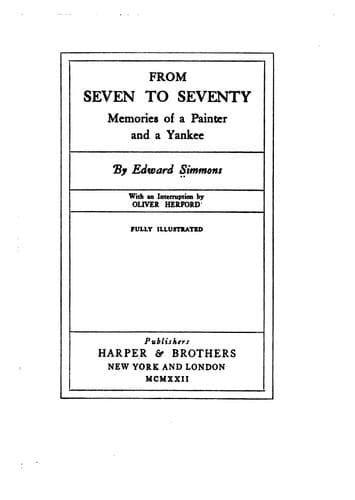
From Seven to Seventy: Memories of a Painter and a YankeeSimmons, Edward
General
From Seven to Seventy: Memories of a Painter and a Yankee
Simmons, Edward
Artists -- Biography
We sometimes went to the Closerie des Lilas, at the corner of the
Boulevard St.-Martin. This was quite in the country, in the days of
Henri Quatre—a sort of road house where the young bloods went to drink.
The women of the court discovered this and used to go out there,
disguised as milkmaids, and flirt outrageously with the tipsy members of
the nobility. Alas! the lilacs are gone now and sportive milkmaids no
longer frequent the place; but the Cafe des Lilas still has its stories,
and in my day there was at least one interesting habitué. He was a major
whom everybody knew and spoke to familiarly. He was gray bearded and
must have had his title from the Franco-Prussian War. He and his cronies
had the same table, played piquet, and sat for hours over their coffee.
His was a _mazagran_. The first time I saw him I noticed he had a funny
trick which he repeated every night. For a _mazagran_ the waiter leaves
three lumps of sugar; he always used two, left the other in his saucer,
and became exceedingly annoyed if, by any chance, it got wet. In his
right-hand waistcoat pocket was his watch, with a great fob that went
across. With the utmost deliberation, he would reach into the left-hand
pocket, take out a piece of brown paper, beautifully cut into a square,
and fold into it the extra lump of sugar, carefully putting the package
back in his pocket again. For many nights I watched this proceeding and
made up my mind that, being a thrifty Frenchman, he used it for his
morning coffee. But not so. Some time after, I read in the Figaro that
Major P—— who lived in Montparnasse (there was no mistaking the name and
place), had died suddenly, leaving no estate and no personal effects;
but behind the door of his small bedroom had been found—a cubic yard of
sugar!
Verlaine sometimes came to this café—Paul Verlaine; I often paid for his
beer. A plain, hairy, dirty figure, seeming physically very feeble; you
would not think to look at him twice except to marvel at his ugliness
and disorderly appearance, unless you saw his eyes. If he looked at you,
you knew you were in the presence of your better. He was worshiped by
all, and they fought to pay his check, hovering about him like crows
around dead carrion, waiting to snatch at anything that dropped from his
lips. I was not a good student of character in those days and in no way
realized his importance, but I could not help feeling his charm. One
night I had a dispute with a Frenchman as to what was the meaning of
courage. One of us argued that it was an admirable quality, and the
other that it was vanity and stupidity—therefore, idiotic. At the height
of the discussion Verlaine came in and was appealed to to decide the
question. He first demanded beer and then listened carefully to one and
then the other. Looking at me, he said:
“I decide for the young American.”
“Well, why?” asked the Frenchman.
“Because you are right and he is right; you are wrong and he is wrong.
But _he_ believes what he says.”
Public-domain text, read in full here on John Shaqi.
Reviews
Reviews
No reviews yet
Be the first to share your thoughts on this work.
Elsewhere in the archive
Join the Discussion
Join the discussion
Sign in to leave a comment or review.
Sign InorCreate an account