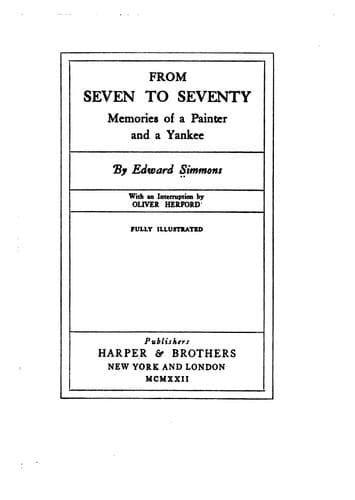
From Seven to Seventy: Memories of a Painter and a YankeeSimmons, Edward
General
From Seven to Seventy: Memories of a Painter and a Yankee
Simmons, Edward
Artists -- Biography
To him, _truth_ was of no importance—the question was _belief_—and this
seems to me to be the secret of his whole philosophy.
There is a corner in Paris where Arthur Cosslet Smith says, if you sit
there long enough, you will meet everyone of importance of your day—the
corner of the Café de la Paix. Here one day I was sitting, having an
_apéritif_ before lunch; at a table in the corner was gathered a group
of _jeunesses dorées_ and a little farther back I noticed Barbey
d’Aurevilly. The young men began to discuss literature with that
cocksureness that is the quality of youth the world over. Victor Hugo
was still alive, and it was the fashion to “knock” him, which they
proceeded to do, outrageously. Finally, one said, so the whole café
could hear:
“Oh, your Victor Hugo, he is stupid.”
At that I _felt_ a figure rise behind me and come forward; then I saw
this wonderful vision. About seventy, handsome, tall, dressed with the
most exquisite care, lace at his sleeves and neck; D’Aurevilly was a
count and noted duelist and distinctly of the old school. Looking as if
he had stepped straight out of a book of Dumas’, he walked up to the
young men. Instantly, their conversation was hushed. He did not present
himself, but said:
“My young friends, I also care for literature; and that is my excuse for
speaking to you. I heard your talk of Victor Hugo and I came to tell you
that I agree with you in your estimate of him. Alas! he _is_
stupid—stupid as the Himalayas!” (“_Il est bête——bête comme les
Himalays!_”)
We are fond of saying that things are not the same as they were when we
were young, but I fear we are wrong. The change is in ourselves. When I
went back to Paris in 18—— I visited some of the old familiar haunts.
One was the little café, where I used to breakfast every morning when a
student. Everything looked the same—the dingy walls, dirty floor, but
spotless tables—as the French tables always are; the waiters calling out
the orders for their well-known patrons as soon as they showed their
faces in the doorway; the poor, half-starved grisettes eating their
sou’s worth of bread—I could hardly believe I had been away for so many
years.
But why did the food taste so strange? The _croissons_ were soggy, and
the coffee, with its abominable taste of chicory—bah! Was it possible I
could once have lived on this fare and actually liked it? I could not
even call back one old thrill.
After such a disappointment, I was almost afraid to visit Julian’s, but
with rather a sinking heart I turned into the Passage de Panorama,
around the corner to the galerie, up the still dirty stairway, and
opened the door. Instantly I was greeted with French oaths and comments,
and I found myself running a barricade of paint tubes and what seemed to
me all the furniture in the room, hurled at my head. I stopped and swore
in every language I knew, crying:
Public-domain text, read in full here on John Shaqi.
Reviews
Reviews
No reviews yet
Be the first to share your thoughts on this work.
Elsewhere in the archive
Join the Discussion
Join the discussion
Sign in to leave a comment or review.
Sign InorCreate an account