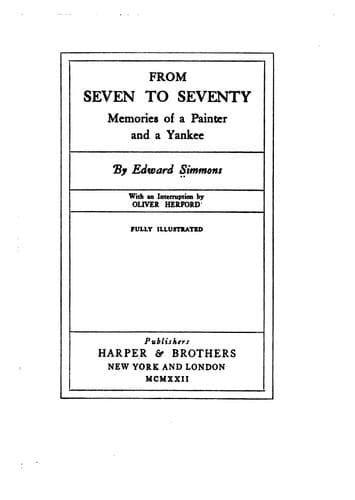
From Seven to Seventy: Memories of a Painter and a YankeeSimmons, Edward
General
From Seven to Seventy: Memories of a Painter and a Yankee
Simmons, Edward
Artists -- Biography
“If anyone here is as old an _ancien_ as I, I’ll kneel to him, but if
not, get down on your knees, the whole crowd of you!”
“Who are you?” they asked.
I pointed to the wall where hung a drawing—the very one which had won me
the hundred francs in the contest. Instantly everyone in the room was on
his knees.
The tears streamed down my cheeks; I was not disappointed. My old Paris
had come back to me!
Chapter VI: The Middle Ages
_Brittany; Spain_
America is a country without tradition, and the large cities of Europe
are too cosmopolitan to impress one with the fact of fixed manners and
morals. But not so in the provinces. From ’81 to ’86, I lived in
Concarneau, on the Breton coast, and made a trip of several months into
Elche, Spain. I felt as if I had suddenly plunged back into the Middle
Ages. The superstitions, manners, customs, and dress, as well as ideas,
of both those places, were unchanged from centuries ago.
Around the part of Concarneau where the poor live is a wall built by
Vauban; inside is a fortress with the sea making a moat. The bridge,
which could originally be drawn up, is now stationary, but the doorway
for a passage is still there. On the other side is the ferry to Pont
Aven. Inside the inclosure the streets are narrow and paved, with little
houses on either side. Outside is the smart part of the town. The
beauties of the sea, and, as usual, the low cost of living, brought the
artist to Concarneau.
My studio was a wheat loft, and any peasant was a model for a few cents.
We painted them in their native dress, which was picturesque enough,
and, besides, no virtuous Breton woman would allow you to see her hair,
so that it was obvious that the coif stayed on. These headdresses gave
them a distinctly mediæval air, and each town has a certain style, more
fixed than the laws of the Medes and Persians, so that you can tell
immediately where a woman comes from. Underneath this white coif, which
is always beautifully laundered and starched, is a tight cap which holds
the hair, and this, I think, is seldom removed. The remainder of the
costume (which makes them look like Noah’s Ark women) is a heavy woolen
skirt and a double-breasted blouse. This is held together by a huge
shawl pin of brass, and under no circumstances can they be persuaded to
use buttons. Of course there are stockings and sabots.
Blanch Willis Howard wrote her book called _Guenn_ in my studio and it
afterward became one of the popular novels of the day. I think she
greatly exaggerated the romantic quality of the artist who fell in love
with his model, however, as all the Breton peasants I ever saw washed
below the chin only twice in their lives—once when they were born and
once when married.
Public-domain text, read in full here on John Shaqi.
Reviews
Reviews
No reviews yet
Be the first to share your thoughts on this work.
Elsewhere in the archive
Join the Discussion
Join the discussion
Sign in to leave a comment or review.
Sign InorCreate an account