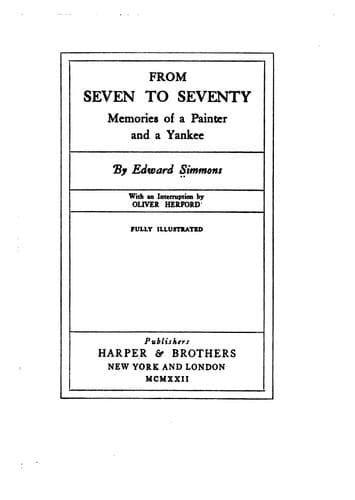
From Seven to Seventy: Memories of a Painter and a YankeeSimmons, Edward
General
From Seven to Seventy: Memories of a Painter and a Yankee
Simmons, Edward
Artists -- Biography
Bastien was one of the most lovable men I ever met, bright, smiling,
with a certain undercurrent of sadness—the mark of tuberculosis was upon
him then. I remember one day attempting to tell him the meaning of an
American negro song he had learned from one of the boys, but he refused
to listen, not wishing to be disillusioned.
“No, no, Simmons, I do not wish to have it explained. I know what it
says. It is a pathetic song of a lover mourning for one he has lost.”
And he rendered it in a voice that would have brought tears to the eyes
of the average audience.
“Ze lobstere in ze lobstere pot
Ze bluefish in ze panne;
Zey suffere, oh, zey suffere not;
What I suffere for my Marie Anne.”
Poor Bastien! He was gone the next year.
It is almost impossible to speak of Bastien without mentioning that
young woman, made famous by the remark of Gladstone that she had written
the best book of the year, the woman who meant so much in his life—Marie
Bashkirtsev. Fresh from the hands of her maid, she was a fascinating
blond “vamp,” but in about twenty minutes the charms began to go. Her
hair became unruly, buttons refused to do their duty, and slipper
strings burst. She had beautiful feet and was inclined to wear her shoes
too small. I once sent her a message saying that I would give her a
sketch for one of her slippers. She replied:
“I know the value of a new pair of slippers, but I do not know the value
of one of your pictures.”
On the apartment mantelpiece of Bojidar Karageorgivitch was a semicircle
of shoes, a slipper in the center, and two bell jars covering riding
boots at either end—all belonging to his cousin Marie. Borjidar was a
charming person; the son of a king, his mother a Russian princess and
second in line for the Serbian throne. His brother Nicolas was a
weakling, and Peter, the king, was no good. Slight, pointed beard, and
aquiline nose, he looked more the fashionable Frenchman than anything
else. Like Pierre Loti, he was smitten with the divine Sarah, who
visited him at Concarneau and left her painting materials behind.
Borjidar always seemed to be surrounded with a halo of romance. One day
we were sitting out on the pavement and some one mentioned thumb-nails.
It is said that the larger the white moons, the greater the aristocrat.
This royal prince had no moon at all, thus indicating no ancestry; but
if the sign is true, it is not strange, since his grandfather had been
an ignorant butcher who had jumped the throne. Through his mother he had
a delightful touch. Years later I met Bojidar in Paris, and what do you
suppose he was doing? Such a brave, fine thing! He was selling jewelry,
which he designed himself, to the English snob and really making good at
it. Many people like to buy from the son of a king.
Public-domain text, read in full here on John Shaqi.
Reviews
Reviews
No reviews yet
Be the first to share your thoughts on this work.
Elsewhere in the archive
Join the Discussion
Join the discussion
Sign in to leave a comment or review.
Sign InorCreate an account