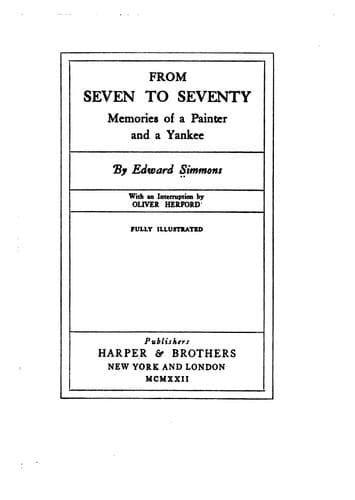
From Seven to Seventy: Memories of a Painter and a YankeeSimmons, Edward
General
From Seven to Seventy: Memories of a Painter and a Yankee
Simmons, Edward
Artists -- Biography
There came to Concarneau a young girl, wide eyed, eager, temperamental,
thirsting for a knowledge of life, but knowing about as much of it as
the bird just out of the egg. She was alone and studying Art. She asked
of the women folk the meaning of marriage, and wanted to be chaperoned
until she had made up her mind whether to take the big step or not. Not
so long after her enlightenment, she announced her wedding, and with
none other than the now well-known writer—Havelock Ellis. Ellis seems to
me an example of a man who took up one subject, stuck to it, and
absorbed it thoroughly—a procedure almost always destined for success
when accompanied by brains. Some years after, I visited the Ellises in
England. There had been no children from the union, but the one-time
timid and childish wife had developed into a charming woman, and,
strange to say, a full-fledged raiser of blooded stock. She it was who
tended the wants of the baby bulls and colts, was in at the births and
deaths of the animals; while Havelock sat by the warmth of his very
delightful fireplace, smoking his pipe and probably mulling over the
psychological effect of all this on the feminine mind. Anyway, I had a
delightful time and, upon his refusal to help her, I held the head of a
baby calf while she slipped a dose of oil down its throat, oblivious to
the fact that I was ruining a beautiful new pair of white flannel
trousers.
Halfway between Concarneau and Pont Aven (that place of predigested food
for artists and ready-made motifs) at the summit of a rise in the road,
is the Rocking Stone. It is twenty feet in diameter, almost spherical in
shape, and so poised by the glacial period upon another buried stone,
that, if pressed at a certain angle, it rocks. The legend is that the
stone gained this quality at the hands of the comtesse of the château,
whose husband went to the Crusades and left her, a bride, to his dearest
friend to take care of. This he proceeded to do by trying to make her
his mistress; he was rebuffed and became her enemy. Upon her husband’s
return from the wars, this so-called friend rushed ahead to meet him and
told him his wife had betrayed him. The count drew his sword, walked
ahead to meet her, and accused her of the infidelity. She placed her
hand on the stone and said:
“God is my witness that it is a lie and, if I am chaste, will move this
stone.”
Thereupon, she touched it ever so lightly, and it rocked!
It was a habit of the peasants and fishermen to take their sweethearts
to this place to see if they could move the bowlder. On such
superstitions does the virtue of a woman hang.
* * * * *
Public-domain text, read in full here on John Shaqi.
Reviews
Reviews
No reviews yet
Be the first to share your thoughts on this work.
Elsewhere in the archive
Join the Discussion
Join the discussion
Sign in to leave a comment or review.
Sign InorCreate an account