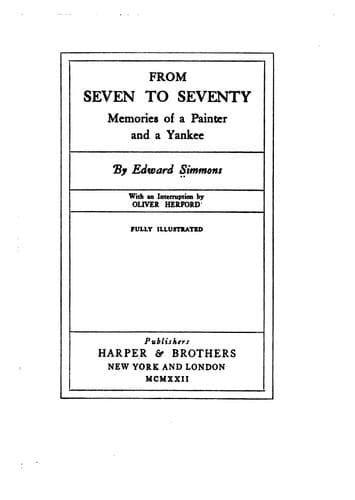
From Seven to Seventy: Memories of a Painter and a YankeeSimmons, Edward
General
From Seven to Seventy: Memories of a Painter and a Yankee
Simmons, Edward
Artists -- Biography
There is no art among the provincial people of Spain. In fact, I do not
know any place where there is such an utter indifference to it. Once the
hotel keeper came into my bedroom and saw a water color I had done
hanging on the wall. It was a careful rendition of the passageway in
front of my room. There were the tiles on the floor, the plaster walls
with the door halfway down, and, at the end, beneath a window, stood a
large jar (exactly like the one in which I imagine the Forty Thieves
were concealed) full of pampas grass. I should have thought a child
would have recognized it. But mine host said, politely:
“One of your artistic results from our river?”
“No,” emphatically.
“Oh, then it is the cathedral?”
I gave it up. Had I been a sensitive man, I think I would have stopped
painting then and there.
The Church is the doctor, lawyer, teacher, amanuensis, and theater. The
festivals are more beautiful than I have seen anywhere. From May to
October there is never a cloud in the sky, and during this time is held
the Fiesta de la Vieja Negra. The ceremony takes place in the public
square, and at midnight of that July night the roofs of the town are
crowded with people while the sky looks like an inverted bowl of black
over their heads. The legend is that the little Virgin, only three feet
high and carved out of dark wood, landed in a boat on the shores of the
Mediterranean. In her hand was a scroll which directed that she be drawn
inland by two white oxen and that where they lay down must be built a
temple. This is the Cathedral of Elche, the roof of which is of blue
tiles and glitters like an amethyst or turquoise. The procession of the
fiesta begins at twelve o’clock and proceeds in stately fashion to the
square. Everything connected with the Virgin herself is
black—black-robed priests, black casket and draperies—with all else a
blaze of light and color. I was much affected and ready to fall on my
knees and become a Roman Catholic. The mayor, in evening clothes, awaits
her, carrying in his hand a black velvet flag about ten by twelve feet,
with no insignia. When the procession stops he walks solemnly forward,
all alone, across the square. When directly in front of the Virgin he
raises the flag in his hands and, amid dead silence, waves it slowly in
her face, back and forth. The third time the staff snaps and down falls
the flag at her feet. There is a wild yell of: “Fiesta! Fiesta!”
Everyone believes a miracle has happened.
The story is that when the Vieja was first installed, a Moorish
Chieftain jeered at her and waved his flag in her face, wherefore she
caused it to break in his hand, and he fell down converted. Now year
after year the miracle is repeated. I was told that the flagpole is cut
to the center on one diameter and gauged, when turned, to break at the
right moment.
Public-domain text, read in full here on John Shaqi.
Reviews
Reviews
No reviews yet
Be the first to share your thoughts on this work.
Elsewhere in the archive
Join the Discussion
Join the discussion
Sign in to leave a comment or review.
Sign InorCreate an account