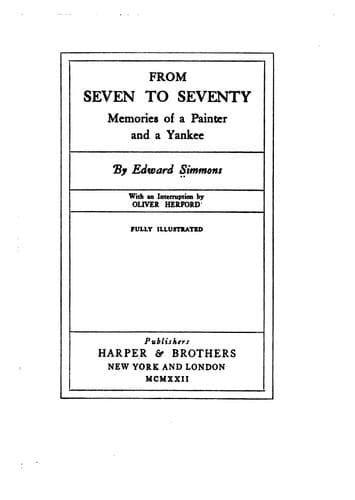
From Seven to Seventy: Memories of a Painter and a YankeeSimmons, Edward
General
From Seven to Seventy: Memories of a Painter and a Yankee
Simmons, Edward
Artists -- Biography
One could almost forgive the superstitious and general ignorance of the
Mediæval Age when one realizes the beautiful things that have been
bequeathed to us. Nothing could be more fascinatingly romantic or more
un-Yankee than the Sereno—the man appointed by the city to go about at
night announcing the time and the weather. His name, meaning “serene,”
comes from the fact that the weather is nearly always clear. In fact,
during all the time that I was in Spain there was only one day when I
saw a cloud in the sky, and I am afraid I should have missed that if my
attention had not been called to it by a proud native.
On these clear blue evenings you would go to bed amid a profound silence
and just be dozing off into a half dream, when away down the street
would come to your ear two or three weird little notes, faint and far
away, seeming to be part of a song or the cry of a bird. Perhaps you
would go back to sleep, and again it would seem only five minutes, but
in reality it would be a half hour—would come the sound, this time
nearer and much more distinct. Each repetition would be louder, until
you would hear the “toc, toc, toc,” of his stick, stopping now and then
as he banged on the door of some heavy sleeper who had paid the Sereno
to wake him. Perhaps he wanted to make a train—or was it “reasons of
love”?
Then right under your window would come the song, “Eleven
o’clock—Serene,” beginning loud and finally disappearing into the night.
[Illustration: Las do-ze y Me-di-a Se-ra-no.]
The Spanish nature is a mixture of politeness and cruelty. There is
something to excite the blood every day. I have seen them gather
together all the stray dogs and give them poison, then heap them up at
the corners of the street. Those that are not dead escape and run away
howling, and the great sport is to jerk them up on a rope, hurling them
high in the air. Everyone thinks this a splendid game and the children
yell with glee. But as to the manners—those of an illiterate farmer are
better than the average clubman’s of New York. If a Spaniard offers you
anything three times, you must accept it, and then offer him something
three times so that he may accept. I remember a farmhand hailing an
old-fashioned coach which ran from Elche to Alicante. Boarding it
slowly, he raised his hat to everyone, saying:
“Good morning, ladies and gentlemen. Will you permit me?” Rolling a
cigarette, he was suddenly struck with a thought, and, turning, offered
the tobacco to the coach in general. In a café, if you sit down beside
anyone—peasant, priest, or dude—he offers you a drink. The third time
you are obliged to accept. The same formula is gone through with in
every situation in life (like the Arabian who must always walk with a
guest to the limit of his property), but I rather think democracy is
doing away with it.
Public-domain text, read in full here on John Shaqi.
Reviews
Reviews
No reviews yet
Be the first to share your thoughts on this work.
Elsewhere in the archive
Join the Discussion
Join the discussion
Sign in to leave a comment or review.
Sign InorCreate an account