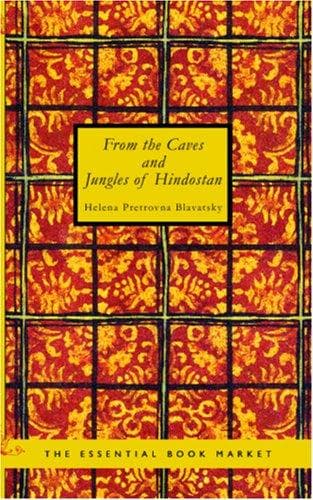
From the Caves and Jungles of HindostanBlavatsky, H. P. (Helena Petrovna)
Religion
From the Caves and Jungles of Hindostan
Blavatsky, H. P. (Helena Petrovna)
Blavatsky, H. P. (Helena Petrovna), 1831-1891; India -- Description and travel; India -- Religion
In short, all the attempts to re-establish the pure primitive monotheism
of Aryan India have been a failure. They always got wrecked upon the
double rock of Brahmanism and of prejudices centuries old. But lo! here
appears unexpectedly the pandit Dayanand. None, even of the most
beloved of his disciples, knows who he is and whence he comes. He openly
confesses before the crowds that the name under which he is known is not
his, but was given to him at the Yogi initiation.
The mystical school of Yogis was established by Patanjali, the founder
of one of the six philosophical systems of ancient India. It is supposed
that the Neo-platonists of the second and third Alexandrian Schools were
the followers of Indian Yogis, more especially was their theurgy brought
from India by Pythagoras, according to the tradition. There still exist
in India hundreds of Yogis who follow the system of Patanjali, and
assert that they are in communion with Brahma. Nevertheless, most of
them are do-nothings, mendicants by profession, and great frauds, thanks
to the insatiable longing of the natives for miracles. The real Yogis
avoid appearing in public, and spend their lives in secluded retirement
and studies, except when, as in Dayanand's case, they come forth in
time of need to aid their country. However, it is perfectly certain that
India never saw a more learned Sanskrit scholar, a deeper metaphysician,
a more wonderful orator, and a more fearless denunciator of every evil,
than Dayanand, since the time of Sankharacharya, the celebrated founder
of the Vedanta philosophy, the most metaphysical of Indian systems,
in fact, the crown of pantheistic teaching. Then, Dayanand's personal
appearance is striking. He is immensely tall, his complexion is pale,
rather European than Indian, his eyes are large and bright, and his
greyish hair is long. The Yogis and Dikshatas (initiated) never cut
either their hair or beard. His voice is clear and loud, well calculated
to give expression to every shade of deep feeling, ranging from a sweet
childish caressing whisper to thundering wrath against the evil doings
and falsehoods of the priests. All this taken together produces an
indescribable effect on the impressionable Hindu. Wherever Dayanand
appears crowds prostrate themselves in the dust over his footprints;
but, unlike Babu Keshub Chunder Sen, he does not teach a new
religion, does not invent new dogmas. He only asks them to renew their
half-forgotten Sanskrit studies, and, having compared the doctrines of
their forefathers with what they have become in the hands of Brahmans,
to return to the pure conceptions of Deity taught by the primitive
Rishis--Agni, Vayu, Aditya, and Anghira--the patriarchs who first gave
the Vedas to humanity. He does not even claim that the Vedas are a
heavenly revelation, but simply teaches that "every word in these
scriptures belongs to the highest inspiration possible to the earthly
man, an inspiration that is repeated in the history of humanity, and,
Public-domain text, read in full here on John Shaqi.
Reviews
Reviews
No reviews yet
Be the first to share your thoughts on this work.
Join the Discussion
Join the discussion
Sign in to leave a comment or review.
Sign InorCreate an account