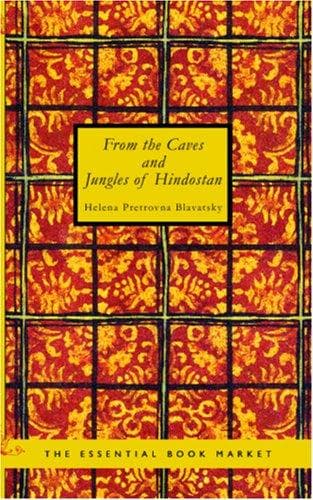
From the Caves and Jungles of HindostanBlavatsky, H. P. (Helena Petrovna)
Religion
From the Caves and Jungles of Hindostan
Blavatsky, H. P. (Helena Petrovna)
Blavatsky, H. P. (Helena Petrovna), 1831-1891; India -- Description and travel; India -- Religion
"Oh, this is not a very rare piece of information. Some of your Western
Orientalists have it in their books. But I personally found it in an
ancient Sanskrit book, translated from the Chinese in the second century
before your era. But the original is to be found in a very ancient work,
named The Preserver of the Five Chief Virtues. It is a kind of chronicle
or treatise on the development of music in China. It was written by the
order of Emperor Hoang-Tee many hundred years before your era."
"Do you think, then, that the Chinese ever understood anything about
music?" said the colonel, with an incredulous smile. "In California and
other places I heard some traveling artists of the celestial empire.
Well, I think, that kind of musical entertainment would drive any one
mad."
"That is exactly the opinion of many of your Western musicians on the
subject of our ancient Aryan, as well as of modern Hindu, music. But, in
the first instance, the idea of melody is perfectly arbitrary; and, in
the second, there is a good deal of difference between the technical
knowledge of music, and the creation of melodies fit to please the
educated, as well as the uneducated, ear. According to technical theory,
a musical piece may be perfect, but the melody, nevertheless, may be
above the understanding of an untrained taste, or simply unpleasant.
Your most renowned operas sound for us like a wild chaos, like a rush of
strident, entangled sounds, in which we do not see any meaning at all,
and which give us headaches. I have visited the London and the Paris
opera; I have heard Rossini and Meyer-beer; I was resolved to render
myself an account of my impressions, and listened with the greatest
attention. But I own I prefer the simplest of our native melodies to the
productions of the best European composers. Our popular songs speak to
me, whereas they fail to produce any emotion in you. But leaving the
tunes and songs out of question, I can assure you that our ancestors,
as well as the ancestors of the Chinese, were far from inferior to the
modern Europeans, if not in technical instrumentation, at least in their
abstract notions of music."
"The Aryan nations of antiquity, perhaps; but I hardly believe this in
the case of the Turanian Chinese!" said our president doubtfully.
Public-domain text, read in full here on John Shaqi.
Reviews
Reviews
No reviews yet
Be the first to share your thoughts on this work.
Elsewhere in the archive
Join the Discussion
Join the discussion
Sign in to leave a comment or review.
Sign InorCreate an account