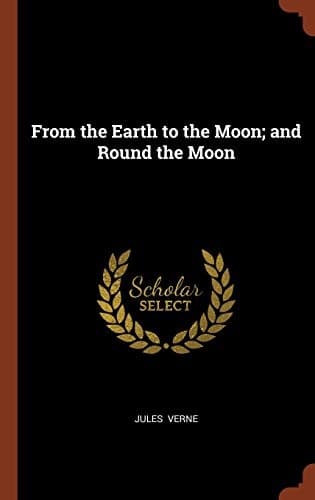
From the Earth to the moon; and, round the moonVerne, Jules
Science
From the Earth to the moon; and, round the moon
Verne, Jules
Manned space flight -- Fiction; Moon -- Fiction; Science fiction; Space flight to the moon -- Fiction; Space ships -- Fiction
“I am sure of it.”
“Philosophers like Plato, Aristotle, Descartes, Kant?”
“I have no doubt of it.”
“Scientific men like Archimedes, Euclid, Pascal, Newton?”
“I could swear it.”
“Comic writers like Arnal, and photographers like—like Nadar?”
“Certain.”
“Then, friend Barbicane, if they are as strong as we are, and even
stronger—these Selenites—why have they not tried to communicate with
the earth? why have they not launched a lunar projectile to our
terrestrial regions?”
“Who told you that they have never done so?” said Barbicane seriously.
“Indeed,” added Nicholl, “it would be easier for them than for us, for
two reasons; first, because the attraction on the moon’s surface is six
times less than on that of the earth, which would allow a projectile to
rise more easily; secondly, because it would be enough to send such a
projectile only at 8,000 leagues instead of 80,000, which would require
the force of projection to be ten times less strong.”
“Then,” continued Michel, “I repeat it, why have they not done it?”
“And I repeat,” said Barbicane; “who told you that they have not done
it?”
“When?”
“Thousands of years before man appeared on earth.”
“And the projectile—where is the projectile? I demand to see the
projectile.”
“My friend,” replied Barbicane, “the sea covers five-sixths of our
globe. From that we may draw five good reasons for supposing that the
lunar projectile, if ever launched, is now at the bottom of the
Atlantic or the Pacific, unless it sped into some crevasse at that
period when the crust of the earth was not yet hardened.”
“Old Barbicane,” said Michel, “you have an answer for everything, and I
bow before your wisdom. But there is one hypothesis that would suit me
better than all the others, which is, the Selenites, being older than
we, are wiser, and have not invented gunpowder.”
At this moment Diana joined in the conversation by a sonorous barking.
She was asking for her breakfast.
“Ah!” said Michel Ardan, “in our discussion we have forgotten Diana and
Satellite.”
Immediately a good-sized pie was given to the dog, which devoured it
hungrily.
“Do you see, Barbicane,” said Michel, “we should have made a second
Noah’s ark of this projectile, and borne with us to the moon a couple
of every kind of domestic animal.”
“I dare say; but room would have failed us.”
“Oh!” said Michel, “we might have squeezed a little.”
“The fact is,” replied Nicholl, “that cows, bulls, and horses, and all
ruminants, would have been very useful on the lunar continent, but
unfortunately the car could neither have been made a stable nor a
shed.”
“Well, we might have at least brought a donkey, only a little donkey;
that courageous beast which old Silenus loved to mount. I love those
old donkeys; they are the least favored animals in creation; they are
not only beaten while alive, but even after they are dead.”
“How do you make that out?” asked Barbicane. “Why,” said Michel, “they
make their skins into drums.”
Public-domain text, read in full here on John Shaqi.
Reviews
Reviews
No reviews yet
Be the first to share your thoughts on this work.
Elsewhere in the archive
Join the Discussion
Join the discussion
Sign in to leave a comment or review.
Sign InorCreate an account