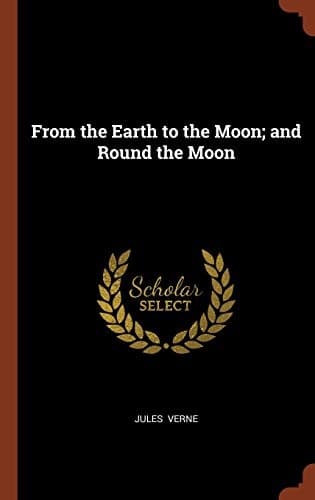
From the Earth to the moon; and, round the moonVerne, Jules
Science
From the Earth to the moon; and, round the moon
Verne, Jules
Manned space flight -- Fiction; Moon -- Fiction; Science fiction; Space flight to the moon -- Fiction; Space ships -- Fiction
Barbicane and Nicholl could not help laughing at this ridiculous
remark. But a cry from their merry companion stopped them. The latter
was leaning over the spot where Satellite lay. He rose, saying:
“My good Satellite is no longer ill.”
“Ah!” said Nicholl.
“No,” answered Michel, “he is dead! There,” added he, in a piteous
tone, “that is embarrassing. I much fear, my poor Diana, that you will
leave no progeny in the lunar regions!”
Indeed the unfortunate Satellite had not survived its wound. It was
quite dead. Michel Ardan looked at his friends with a rueful
countenance.
“One question presents itself,” said Barbicane. “We cannot keep the
dead body of this dog with us for the next forty-eight hours.”
“No! certainly not,” replied Nicholl; “but our scuttles are fixed on
hinges; they can be let down. We will open one, and throw the body out
into space.”
The president thought for some moments, and then said:
“Yes, we must do so, but at the same time taking very great
precautions.”
“Why?” asked Michel.
“For two reasons which you will understand,” answered Barbicane. “The
first relates to the air shut up in the projectile, and of which we
must lose as little as possible.”
“But we manufacture the air?”
“Only in part. We make only the oxygen, my worthy Michel; and with
regard to that, we must watch that the apparatus does not furnish the
oxygen in too great a quantity; for an excess would bring us very
serious physiological troubles. But if we make the oxygen, we do not
make the azote, that medium which the lungs do not absorb, and which
ought to remain intact; and that azote will escape rapidly through the
open scuttles.”
“Oh! the time for throwing out poor Satellite?” said Michel.
“Agreed; but we must act quickly.”
“And the second reason?” asked Michel.
“The second reason is that we must not let the outer cold, which is
excessive, penetrate the projectile or we shall be frozen to death.”
“But the sun?”
“The sun warms our projectile, which absorbs its rays; but it does not
warm the vacuum in which we are floating at this moment. Where there is
no air, there is no more heat than diffused light; and the same with
darkness; it is cold where the sun’s rays do not strike direct. This
temperature is only the temperature produced by the radiation of the
stars; that is to say, what the terrestrial globe would undergo if the
sun disappeared one day.”
“Which is not to be feared,” replied Nicholl.
“Who knows?” said Michel Ardan. “But, in admitting that the sun does
not go out, might it not happen that the earth might move away from
it?”
“There!” said Barbicane, “there is Michel with his ideas.”
Public-domain text, read in full here on John Shaqi.
Reviews
Reviews
No reviews yet
Be the first to share your thoughts on this work.
Elsewhere in the archive
Join the Discussion
Join the discussion
Sign in to leave a comment or review.
Sign InorCreate an account