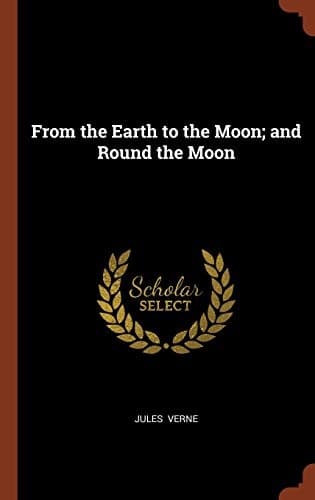
From the Earth to the moon; and, round the moonVerne, Jules
Science
From the Earth to the moon; and, round the moon
Verne, Jules
Manned space flight -- Fiction; Moon -- Fiction; Science fiction; Space flight to the moon -- Fiction; Space ships -- Fiction
They now proceeded to the burial of Satellite. They had merely to drop
him into space, in the same way that sailors drop a body into the sea;
but, as President Barbicane suggested, they must act quickly, so as to
lose as little as possible of that air whose elasticity would rapidly
have spread it into space. The bolts of the right scuttle, the opening
of which measured about twelve inches across, were carefully drawn,
while Michel, quite grieved, prepared to launch his dog into space. The
glass, raised by a powerful lever, which enabled it to overcome the
pressure of the inside air on the walls of the projectile, turned
rapidly on its hinges, and Satellite was thrown out. Scarcely a
particle of air could have escaped, and the operation was so successful
that later on Barbicane did not fear to dispose of the rubbish which
encumbered the car.
CHAPTER VI.
QUESTION AND ANSWER
On the 4th of December, when the travelers awoke after fifty-four
hours’ journey, the chronometer marked five o’clock of the terrestrial
morning. In time it was just over five hours and forty minutes, half of
that assigned to their sojourn in the projectile; but they had already
accomplished nearly seven-tenths of the way. This peculiarity was due
to their regularly decreasing speed.
Now when they observed the earth through the lower window, it looked
like nothing more than a dark spot, drowned in the solar rays. No more
crescent, no more cloudy light! The next day, at midnight, the earth
would be _new_, at the very moment when the moon would be full. Above,
the orb of night was nearing the line followed by the projectile, so as
to meet it at the given hour. All around the black vault was studded
with brilliant points, which seemed to move slowly; but, at the great
distance they were from them, their relative size did not seem to
change. The sun and stars appeared exactly as they do to us upon earth.
As to the moon, she was considerably larger; but the travelers’
glasses, not very powerful, did not allow them as yet to make any
useful observations upon her surface, or reconnoiter her
topographically or geologically.
Thus the time passed in never-ending conversations all about the moon.
Each one brought forward his own contingent of particular facts;
Barbicane and Nicholl always serious, Michel Ardan always enthusiastic.
The projectile, its situation, its direction, incidents which might
happen, the precautions necessitated by their fall on to the moon, were
inexhaustible matters of conjecture.
As they were breakfasting, a question of Michel’s, relating to the
projectile, provoked rather a curious answer from Barbicane, which is
worth repeating. Michel, supposing it to be roughly stopped, while
still under its formidable initial speed, wished to know what the
consequences of the stoppage would have been.
“But,” said Barbicane, “I do not see how it could have been stopped.”
“But let us suppose so,” said Michel.
Public-domain text, read in full here on John Shaqi.
Reviews
Reviews
No reviews yet
Be the first to share your thoughts on this work.
Elsewhere in the archive
Join the Discussion
Join the discussion
Sign in to leave a comment or review.
Sign InorCreate an account