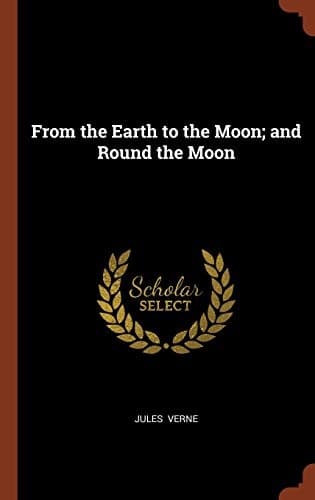
From the Earth to the moon; and, round the moonVerne, Jules
Science
From the Earth to the moon; and, round the moon
Verne, Jules
Manned space flight -- Fiction; Moon -- Fiction; Science fiction; Space flight to the moon -- Fiction; Space ships -- Fiction
“It is an impossible supposition,” said the practical Barbicane;
“unless that impulsive force had failed; but even then its speed would
diminish by degrees, and it would not have stopped suddenly.”
“Admit that it had struck a body in space.”
“What body?”
“Why that enormous meteor which we met.”
“Then,” said Nicholl, “the projectile would have been broken into a
thousand pieces, and we with it.”
“More than that,” replied Barbicane; “we should have been burned to
death.”
“Burned?” exclaimed Michel, “by Jove! I am sorry it did not happen,
‘just to see.’”
“And you would have seen,” replied Barbicane. “It is known now that
heat is only a modification of motion. When water is warmed—that is to
say, when heat is added to it—its particles are set in motion.”
“Well,” said Michel, “that is an ingenious theory!”
“And a true one, my worthy friend; for it explains every phenomenon of
caloric. Heat is but the motion of atoms, a simple oscillation of the
particles of a body. When they apply the brake to a train, the train
comes to a stop; but what becomes of the motion which it had previously
possessed? It is transformed into heat, and the brake becomes hot. Why
do they grease the axles of the wheels? To prevent their heating,
because this heat would be generated by the motion which is thus lost
by transformation.”
“Yes, I understand,” replied Michel, “perfectly. For example, when I
have run a long time, when I am swimming, when I am perspiring in large
drops, why am I obliged to stop? Simply because my motion is changed
into heat.”
Barbicane could not help smiling at Michel’s reply; then, returning to
his theory, said:
“Thus, in case of a shock, it would have been with our projectile as
with a ball which falls in a burning state after having struck the
metal plate; it is its motion which is turned into heat. Consequently I
affirm that, if our projectile had struck the meteor, its speed thus
suddenly checked would have raised a heat great enough to turn it into
vapor instantaneously.”
“Then,” asked Nicholl, “what would happen if the earth’s motion were to
stop suddenly?”
“Her temperature would be raised to such a pitch,” said Barbicane,
“that she would be at once reduced to vapor.”
“Well,” said Michel, “that is a way of ending the earth which will
greatly simplify things.”
“And if the earth fell upon the sun?” asked Nicholl.
“According to calculation,” replied Barbicane, “the fall would develop
a heat equal to that produced by 16,000 globes of coal, each equal in
bulk to our terrestrial globe.”
“Good additional heat for the sun,” replied Michel Ardan, “of which the
inhabitants of Uranus or Neptune would doubtless not complain; they
must be perished with cold on their planets.”
“Thus, my friends,” said Barbicane, “all motion suddenly stopped
produces heat. And this theory allows us to infer that the heat of the
solar disc is fed by a hail of meteors falling incessantly on its
surface. They have even calculated—”
Public-domain text, read in full here on John Shaqi.
Reviews
Reviews
No reviews yet
Be the first to share your thoughts on this work.
Elsewhere in the archive
Join the Discussion
Join the discussion
Sign in to leave a comment or review.
Sign InorCreate an account