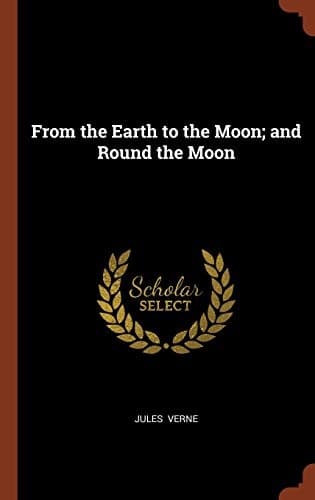
From the Earth to the moon; and, round the moonVerne, Jules
Science
From the Earth to the moon; and, round the moon
Verne, Jules
Manned space flight -- Fiction; Moon -- Fiction; Science fiction; Space flight to the moon -- Fiction; Space ships -- Fiction
“Oh, dear!” murmured Michel, “the figures are coming.”
“They have even calculated,” continued the imperturbable Barbicane,
“that the shock of each meteor on the sun ought to produce a heat equal
to that of 4,000 masses of coal of an equal bulk.”
“And what is the solar heat?” asked Michel.
“It is equal to that produced by the combustion of a stratum of coal
surrounding the sun to a depth of forty-seven miles.”
“And that heat—”
“Would be able to boil two billions nine hundred millions of cubic
myriameters[2] of water.”
[2] The myriameter is equal to rather more than 10,936 cubic yards
English.
“And it does not roast us!” exclaimed Michel.
“No,” replied Barbicane, “because the terrestrial atmosphere absorbs
four-tenths of the solar heat; besides, the quantity of heat
intercepted by the earth is but a billionth part of the entire
radiation.”
“I see that all is for the best,” said Michel, “and that this
atmosphere is a useful invention; for it not only allows us to breathe,
but it prevents us from roasting.”
“Yes!” said Nicholl, “unfortunately, it will not be the same in the
moon.”
“Bah!” said Michel, always hopeful. “If there are inhabitants, they
must breathe. If there are no longer any, they must have left enough
oxygen for three people, if only at the bottom of ravines, where its
own weight will cause it to accumulate, and we will not climb the
mountains; that is all.” And Michel, rising, went to look at the lunar
disc, which shone with intolerable brilliancy.
“By Jove!” said he, “it must be hot up there!”
“Without considering,” replied Nicholl, “that the day lasts 360 hours!”
“And to compensate that,” said Barbicane, “the nights have the same
length; and as heat is restored by radiation, their temperature can
only be that of the planetary space.”
“A pretty country, that!” exclaimed Michel. “Never mind! I wish I was
there! Ah! my dear comrades, it will be rather curious to have the
earth for our moon, to see it rise on the horizon, to recognize the
shape of its continents, and to say to oneself, ‘There is America,
there is Europe;’ then to follow it when it is about to lose itself in
the sun’s rays! By the bye, Barbicane, have the Selenites eclipses?”
“Yes, eclipses of the sun,” replied Barbicane, “when the centers of the
three orbs are on a line, the earth being in the middle. But they are
only partial, during which the earth, cast like a screen upon the solar
disc, allows the greater portion to be seen.”
“And why,” asked Nicholl, “is there no total eclipse? Does not the cone
of the shadow cast by the earth extend beyond the moon?”
“Yes, if we do not take into consideration the refraction produced by
the terrestrial atmosphere. No, if we take that refraction into
consideration. Thus let <lower case delta> be the horizontal parallel,
and _p_ the apparent semidiameter—”
“Oh!” said Michel. “Do speak plainly, you man of algebra!”
Public-domain text, read in full here on John Shaqi.
Reviews
Reviews
No reviews yet
Be the first to share your thoughts on this work.
Elsewhere in the archive
Join the Discussion
Join the discussion
Sign in to leave a comment or review.
Sign InorCreate an account