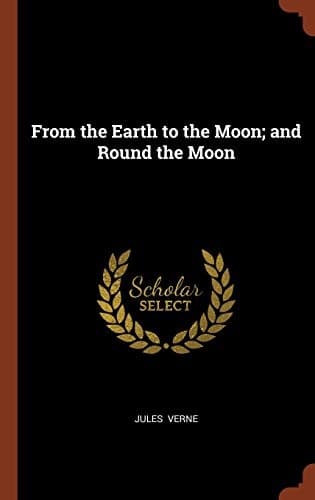
From the Earth to the moon; and, round the moonVerne, Jules
Science
From the Earth to the moon; and, round the moon
Verne, Jules
Manned space flight -- Fiction; Moon -- Fiction; Science fiction; Space flight to the moon -- Fiction; Space ships -- Fiction
If the observer had then specially directed his attention to one of the
more humble and less brilliant of these stellar bodies, a star of the
fourth class, that which is arrogantly called the Sun, all the
phenomena to which the formation of the Universe is to be ascribed
would have been successively fulfilled before his eyes. In fact, he
would have perceived this sun, as yet in the gaseous state, and
composed of moving molecules, revolving round its axis in order to
accomplish its work of concentration. This motion, faithful to the laws
of mechanics, would have been accelerated with the diminution of its
volume; and a moment would have arrived when the centrifugal force
would have overpowered the centripetal, which causes the molecules all
to tend toward the center.
Another phenomenon would now have passed before the observer’s eye, and
the molecules situated on the plane of the equator, escaping like a
stone from a sling of which the cord had suddenly snapped, would have
formed around the sun sundry concentric rings resembling that of
Saturn. In their turn, again, these rings of cosmical matter, excited
by a rotary motion about the central mass, would have been broken up
and decomposed into secondary nebulosities, that is to say, into
planets. Similarly he would have observed these planets throw off one
or more rings each, which became the origin of the secondary bodies
which we call satellites.
Thus, then, advancing from atom to molecule, from molecule to nebulous
mass, from that to principal star, from star to sun, from sun to
planet, and hence to satellite, we have the whole series of
transformations undergone by the heavenly bodies during the first days
of the world.
Now, of those attendant bodies which the sun maintains in their
elliptical orbits by the great law of gravitation, some few in turn
possess satellites. Uranus has eight, Saturn eight, Jupiter four,
Neptune possibly three, and the Earth one. This last, one of the least
important of the entire solar system, we call the Moon; and it is she
whom the daring genius of the Americans professed their intention of
conquering.
The moon, by her comparative proximity, and the constantly varying
appearances produced by her several phases, has always occupied a
considerable share of the attention of the inhabitants of the earth.
Public-domain text, read in full here on John Shaqi.
Reviews
Reviews
No reviews yet
Be the first to share your thoughts on this work.
Join the Discussion
Join the discussion
Sign in to leave a comment or review.
Sign InorCreate an account