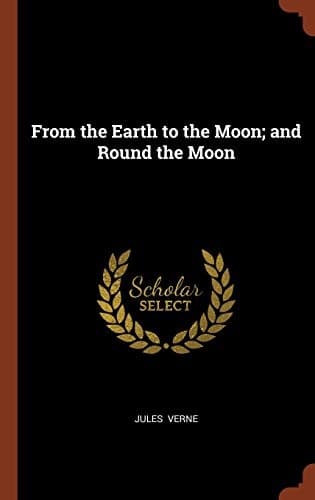
From the Earth to the moon; and, round the moon — John Shaqi
From the Earth to the moon; and, round the moonVerne, Jules
Science
From the Earth to the moon; and, round the moon
Verne, Jules
Manned space flight -- Fiction; Moon -- Fiction; Science fiction; Space flight to the moon -- Fiction; Space ships -- Fiction
“I agree with you, my good friend; and, in fact, following this
proportion for a projectile nine feet in diameter, weighing 30,000
pounds, the gun would only have a length of two hundred and twenty-
five feet, and a weight of 7,200,000 pounds.”
“Ridiculous!” rejoined Maston. “As well take a pistol.”
“I think so too,” replied Barbicane; “that is why I propose to
quadruple that length, and to construct a gun of nine hundred feet.”
The general and the major offered some objections; nevertheless, the
proposition, actively supported by the secretary, was definitely
adopted.
“But,” said Elphinstone, “what thickness must we give it?”
“A thickness of six feet,” replied Barbicane.
“You surely don’t think of mounting a mass like that upon a carriage?”
asked the major.
“It would be a superb idea, though,” said Maston.
“But impracticable,” replied Barbicane. “No, I think of sinking this
engine in the earth alone, binding it with hoops of wrought iron, and
finally surrounding it with a thick mass of masonry of stone and
cement. The piece once cast, it must be bored with great precision, so
as to preclude any possible windage. So there will be no loss whatever
of gas, and all the expansive force of the powder will be employed in
the propulsion.”
“One simple question,” said Elphinstone: “is our gun to be rifled?”
“No, certainly not,” replied Barbicane; “we require an enormous initial
velocity; and you are well aware that a shot quits a rifled gun less
rapidly than it does a smooth-bore.”
“True,” rejoined the major.
The committee here adjourned for a few minutes to tea and sandwiches.
On the discussion being renewed, “Gentlemen,” said Barbicane, “we must
now take into consideration the metal to be employed. Our cannon must
be possessed of great tenacity, great hardness, be infusible by heat,
indissoluble, and inoxidable by the corrosive action of acids.”
“There is no doubt about that,” replied the major; “and as we shall
have to employ an immense quantity of metal, we shall not be at a loss
for choice.”
“Well, then,” said Morgan, “I propose the best alloy hitherto known,
which consists of one hundred parts of copper, twelve of tin, and six
of brass.”
“I admit,” replied the president, “that this composition has yielded
excellent results, but in the present case it would be too expensive,
and very difficult to work. I think, then, that we ought to adopt a
material excellent in its way and of low price, such as cast iron. What
is your advice, major?”
“I quite agree with you,” replied Elphinstone.
“In fact,” continued Barbicane, “cast iron costs ten times less than
bronze; it is easy to cast, it runs readily from the moulds of sand, it
is easy of manipulation, it is at once economical of money and of time.
In addition, it is excellent as a material, and I well remember that
during the war, at the siege of Atlanta, some iron guns fired one
thousand rounds at intervals of twenty minutes without injury.”
Public-domain text, read in full here on John Shaqi.
Reviews
Reviews
No reviews yet
Be the first to share your thoughts on this work.
Join the Discussion
Join the discussion
Sign in to leave a comment or review.
Sign InorCreate an account