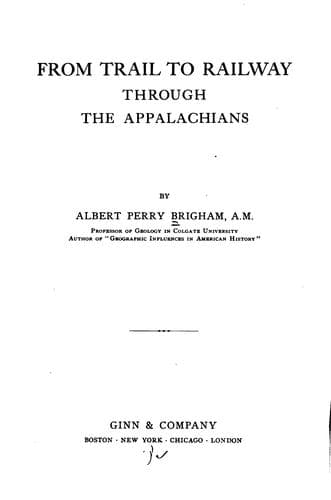
From trail to railway through the AppalachiansBrigham, Albert Perry
History
From trail to railway through the Appalachians
Brigham, Albert Perry
Appalachian Mountains; Atlantic States -- Description and travel; Ohio River Valley -- Description and travel
On our way to Pittsburg we are soon pulling up the Allegheny Front by a
great loop, or bend, which enables the tracks to reach the summit more
than a thousand feet above Altoona. Nestling within the great bend is
a reservoir of water to supply the houses and shops of the city lying
below. Passing the highest point, we find ourselves descending the
valley of the Conemaugh river to Johnstown, and surrounded by the high
lands of the Allegheny plateau.
Johnstown is much older than Altoona, for it was settled in 1791, but
it has not grown so fast, and has only about as many inhabitants as the
city of railroad shops. Most people know of Johnstown because of the
flood which ruined the place in 1889. Several miles above the town was
a reservoir more than two miles long and in several places one hundred
feet deep. After the heavy rains of that spring the dam broke on the
last day of May, and the wild rush of waters destroyed the town. Homes,
stores, shops, and mills were torn away and carried down the river.
Clara Barton of the Red Cross, who went to Johnstown as soon as she
could get there, says that the few houses that were not crushed and
strewn along the valley were turned upside down.
More than two thousand men, women, and children lost their lives, and
those that were left were in mourning and poverty. The whole land sent
in its gifts of money, clothing, and food, and the town was built up
again into a prosperous city. Near the city are found coal, iron,
limestone, and fire clay, and these things make it easy to establish
iron works. The Cambria Steel Company gives work to ten thousand men in
its shops, mines, and furnaces.
The main line of the Pennsylvania Railroad runs down the rugged
Conemaugh valley through Johnstown, and is its chief means of traffic.
As we go on to the west we near Pittsburg, but first we pass through
a number of stirring towns. At one place fire bricks are made, and
the clay for molding them and the coal for burning them are found in
the same hill. In another town there are coal mines and glass works.
Farther west the Pennsylvania road has more repair shops, and Braddock
is the great Carnegie town. We shall see why many thriving young cities
have grown up in this region when we take up Pittsburg, about which
they are all clustered.
At Pittsburg we pull into one of the finest railway stations in the
United States. We may stop in the city of coal and iron, or we may go
on to the west, over one of the main arms of the Pennsylvania Railroad
system. If we take the northern branch, it will carry us across Ohio
to Fort Wayne in Indiana and to Chicago. If we board a train on the
southern arm, we shall go through Columbus and Indianapolis, and be set
down on the farther side of the Mississippi river at St. Louis.
Public-domain text, read in full here on John Shaqi.
Reviews
Reviews
No reviews yet
Be the first to share your thoughts on this work.
Join the Discussion
Join the discussion
Sign in to leave a comment or review.
Sign InorCreate an account