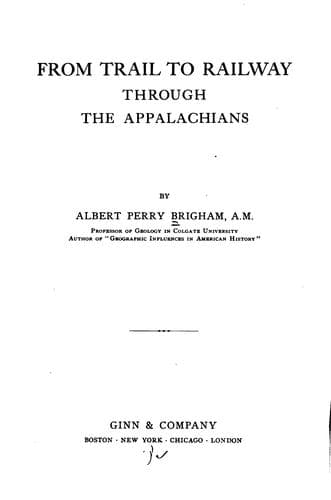
From trail to railway through the AppalachiansBrigham, Albert Perry
History
From trail to railway through the Appalachians
Brigham, Albert Perry
Appalachian Mountains; Atlantic States -- Description and travel; Ohio River Valley -- Description and travel
Besides the Scotch-Irish, there were many Germans who had followed the
valley from Pennsylvania, and there were Huguenots also, besides a few
Hollanders and Swedes. A fort was built on the little river, and around
this defense grew up the Watauga Settlement. There was no Tennessee in
those days.
Many of the settlers had followed down the valleys from earlier homes
in Virginia, and it never occurred to them that they were not still
living in Virginia, and able to call on the colony for help. But after
a time a man came to the settlement who was a surveyor, and for some
reason he thought that he would run the boundary line of Virginia
farther west. When he had done it, what was the surprise of every one
to find that they were not in Virginia at all! If they belonged to any
colony, it was to North Carolina. Unfortunately there was a lack of
good government in that colony, and the prospect of belonging to it
was not a pleasant one; indeed, some of the settlers had run away from
North Carolina, and had felt safer because the great mountains rose
between them and their former home.
There seemed nothing to do but to make a government of their own, so
they formed the Watauga Association, about which writers of American
history have said a good deal. It would be interesting to see a copy
of the constitution that was drawn up by these backwoodsmen, but it
has been lost, with little hope that it will ever be recovered. It
is known, however, that there was a committee of thirteen, really a
legislature. This committee chose five of their own number to form
a court, which had a clerk and a sheriff and made laws for all the
settlers. Roosevelt, in his _Winning of the West_, says that these
pioneers were the first to build a “free and independent community” in
America.
The two most important men of this little state in the wild forest show
us that the settlers came from widely different places. James Robertson
was one, and he came over the mountains from North Carolina. John
Sevier was the other, and he came down the valley from Virginia. We
shall need to know what sort of men these were.
James Robertson belonged to the Scotch-Irish people. He was not one
of the very first settlers at Watauga, but came in the second year,
1770. He had no early education, and his wife, an intelligent woman,
taught him to read. He went alone over the mountains, with only his
horse and gun, in search of a place for a home. He found the settlers
and admired the place which they had chosen, but on his way back in
the fall he lost his horse and got his powder wet. He wandered about,
almost starved, until he met some hunters, who helped him home. He told
his neighbors of the lands in the valley, and as soon as the winter
was over his own family and sixteen others started out for Watauga.
He built a log house, went to work on the land, and by his wisdom and
energy soon came to be a leader of the new colony.
Public-domain text, read in full here on John Shaqi.
Reviews
Reviews
No reviews yet
Be the first to share your thoughts on this work.
Elsewhere in the archive
Join the Discussion
Join the discussion
Sign in to leave a comment or review.
Sign InorCreate an account