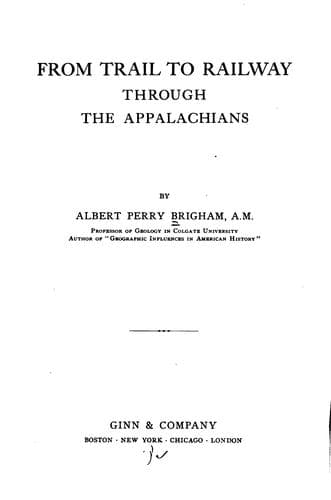
From trail to railway through the AppalachiansBrigham, Albert Perry
History
From trail to railway through the Appalachians
Brigham, Albert Perry
Appalachian Mountains; Atlantic States -- Description and travel; Ohio River Valley -- Description and travel
They moved up the three sides of the hill. Ferguson was famous for his
bayonet charges, and the patriots had no bayonets. So when the British
rushed down on the center of the advancing line the mountaineers gave
way and the enemy pursued them down the hill. Then the backwoodsmen on
the flanks rushed in and poured shot into the backs of the British.
Turning to meet these new foes, the regulars were again chased up the
hill and shot by the men who had fled from their bayonets. Thus shrewd
tactics took the place of weapons. At length the gallant Ferguson
was killed, the white flag was hoisted, and the firing stopped. Many
British were slain, and all the rest, save a very few who escaped in
the confusion, were made prisoners.
[Illustration: FIG. 62. JOHN SEVIER]
It was a wonderful victory for the men from the valley. They had come
from a region of which Cornwallis had hardly dreamed, and they had
destroyed one of his armies and killed one of his best commanders. The
battle turned the tide of the Revolution in the South, but the victors
hurried back as quickly as they had come. They were not fitted for a
long campaign, and, besides, they had left their homes dangerously
open to attacks from savages. It was, however, the one battle of the
Revolution against white foes alone that was planned, fought, and won
by the men of the frontier.
As soon as John Sevier returned to the valley he found plenty of Indian
fighting to do. He was skilled in this, and with the Watauga men, who
called him “Chucky Jack” and were devoted to him, he was a terror to
the red men of the southern mountains. He knew all their tricks and how
to give them back what he called “Indian play.” At one time he took a
band of his followers and made a daring ride into the wildest of the
Great Smokies, to attack some hostile tribes. He burned their villages,
destroyed their corn, killed and captured some of their warriors, and
got away before they could gather their greater numbers to crush him.
We must not forget James Robertson, who all this time was doing his
part of the farming and the fighting and the planning for the new
settlements. Already the Watauga country began to have too many people
and was too thickly settled to suit his temper, and he was thinking
much about the wilderness beyond, near the lower part of the Cumberland
river. In a great bend on the south bank of that stream he founded
Nashborough in 1779, naming it in honor of Oliver Nash, governor of
North Carolina. Five years later it became Nashville, and now we do not
need to explain where it was.
Robertson went out by the Cumberland Gap, but soon left Boone’s
road and went toward the west, following the trails. When he and
his followers reached the place and decided upon it as suitable for
settlement, they planted a field of corn, to have something to depend
on for food later.
Public-domain text, read in full here on John Shaqi.
Reviews
Reviews
No reviews yet
Be the first to share your thoughts on this work.
Elsewhere in the archive
Join the Discussion
Join the discussion
Sign in to leave a comment or review.
Sign InorCreate an account