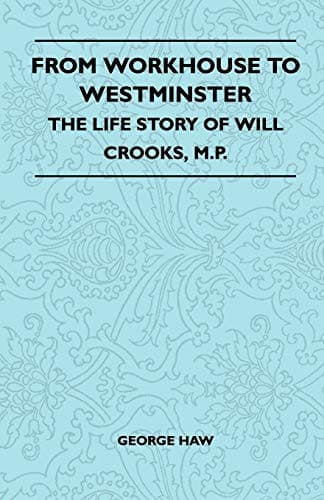
From Workhouse to Westminster: The Life Story of Will Crooks, M.P.Haw, George
History
From Workhouse to Westminster: The Life Story of Will Crooks, M.P.
Haw, George
Crooks, William, 1852-1921; Legislators -- Great Britain -- Biography; Social reformers -- Great Britain -- Biography
"That's all right, then; I'm against it. We needn't go up to
vote--we'll pair."
And Crooks left those British legislators smoking on the Terrace, since
it was too much trouble to them to go inside and vote.
It was on the Terrace one afternoon that a party of titled ladies,
taking tea, sought his acquaintance. They immediately began to lecture
him on his duty to the poor.
"I think you are supremely stupid to bother about the poor as you do,
Mr. Crooks," said one of the dames from behind her fan. "I am told they
are always coming to your house to consult you about their troubles. If
they came to my house I should order them away."
"I'm sure you would, madam."
"And if those dreadful people were only like me they wouldn't listen to
what you tell them."
"I'm sure they wouldn't, madam."
"You needn't be sarcastic, Mr. Crooks. I would send them to the Poor Law
officers or the Charity Organisation people."
And then, as another honourable member joined the party, the good lady
turned to him:
"I'm just teaching Mr. Crooks his place."
"Indeed," said the Labour man, "I thought I was teaching you yours."
It was more agreeable to him when accosted by one of the policemen on
duty in the House.
"Well, Mr. Crooks, how's Poplar?"
"You know Poplar?"
"Yes, I used to be stationed that way. I well remember your Dock Gate
meetings. I liked the Poplar people better than the West Enders. You
take it from me, Mr. Crooks, there's far more respect for law and order
in Poplar than there is in the West End."
He still kept his College by the Dock Gates going, notwithstanding his
election to Parliament. Indeed, he was still as much the servant of
Poplar as of Woolwich.
Parliament, of course, added enormously to his work. Friends urged him
to give up several of his public posts. He was advised to retire from
the Asylums Board, and doubtless would have done so but for a powerful
appeal sent to him not to desert the Board's children. He wanted to
resign from the Poplar Board of Guardians, of which he had then been
Chairman for half a dozen successive years; but all parties in the
borough pleaded with him to remain, and the Conservatives and Liberals
withdrew their candidates in his ward in order that he might be returned
unopposed. He was showered with requests to remain for the sake of the
poor. At last he agreed, on the understanding that he should give less
time to the work. This was perhaps an unwise decision, for owing to the
slackening of his personal vigilance the administration was besmirched
by irregularities which of course laid the Chairman's Poor Law policy
open to the attacks of his opponents.
The only post he gave up was that on the Poplar Borough Council. The
Labour League would not hear of his resigning from the London County
Council, and within a year of his election to Parliament, Poplar
re-elected him to the L.C.C. with a majority of over 1,600.
Public-domain text, read in full here on John Shaqi.
Reviews
Reviews
No reviews yet
Be the first to share your thoughts on this work.
Elsewhere in the archive
Join the Discussion
Join the discussion
Sign in to leave a comment or review.
Sign InorCreate an account