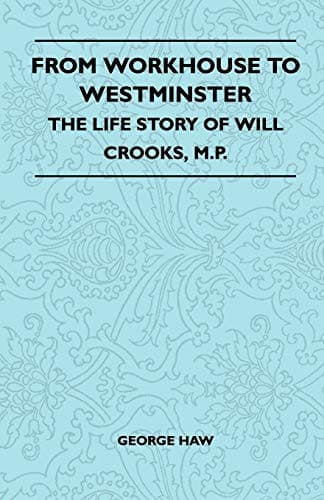
From Workhouse to Westminster: The Life Story of Will Crooks, M.P.Haw, George
History
From Workhouse to Westminster: The Life Story of Will Crooks, M.P.
Haw, George
Crooks, William, 1852-1921; Legislators -- Great Britain -- Biography; Social reformers -- Great Britain -- Biography
We would therefore submit that the municipalities which may decide
to take part in meeting present needs could best do so by leaving
distinctively "relief" duties to Guardians and other agencies; by
starting and carrying on, as good employers, works which have a
definite public advantage, and by requiring of each worker the best
work during a continuous period under thorough supervision.
The most successful scheme for relieving distress with which Crooks was
associated in the severe winters of the early 'nineties was one on which
a dozen years later the Unemployed Act was based. It represented
co-operation between a committee of citizens and the local authorities.
The Committee was formed in the first instance as a relief committee by
the Rector of Poplar. When Crooks joined at the rector's request and
found himself sitting among none but parsons, representing every
denomination in the district, he told them their first duty was to widen
their ranks.
"You will never do anything so long as your committee is confined to
gentlemen like these," he told the clerical chairman. "What you need is
to get hold of trade union secretaries and the secretaries of the
friendly and temperance societies and members of working men's clubs.
They will soon discriminate between the waster and the deserving man.
The waster is always boasting that parsons are so easily deceived."
Besides the Labour men, representatives of other classes were invited to
join the committee. The Bishop of London and Canon Scott Holland backed
up the Committee's appeal to the public for funds, and about £5,000 was
raised to meet Poplar's needs.
It was amusing to see how often the working men members had to undeceive
the parsons. One good vicar tearfully brought forward several cases
which the Labour men proved had been manufactured for him by
professional cadgers.
"I have never known a distress committee to equal that one," was
Crooks's verdict.
It taught him that a shilling given to an unemployed man for work done
was better than a sovereign given simply as charity.
Ever since he has steadily worked for the unemployed under that
conviction. He changed that committee from a relief committee into a
committee for providing work.
In its second winter he received an offer for the unemployed of £1,000
from Mr. A. F. Hills, of the Thames Ironworks, on condition that he
should raise a similar sum. He took the offer at once to the Poplar
District Board, the precursor of the Borough Council. They agreed to
vote another £1,000, and to put men to work on repaving roads and
lime-whiting courts and alleys. So far was the local authority
satisfied with the way the work was done that, after spending Mr.
Hills's £1,000 in wages and the second £1,000 they themselves had
promised, they voted another £3,000 during the prevalence of the
distress.
Public-domain text, read in full here on John Shaqi.
Reviews
Reviews
No reviews yet
Be the first to share your thoughts on this work.
Elsewhere in the archive
Join the Discussion
Join the discussion
Sign in to leave a comment or review.
Sign InorCreate an account