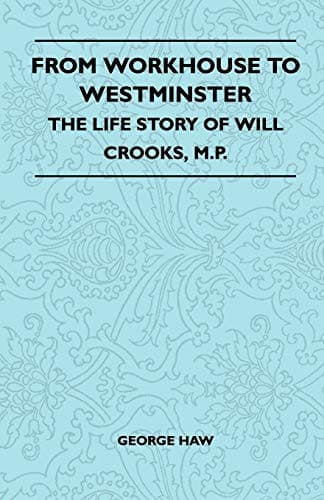
From Workhouse to Westminster: The Life Story of Will Crooks, M.P.Haw, George
History
From Workhouse to Westminster: The Life Story of Will Crooks, M.P.
Haw, George
Crooks, William, 1852-1921; Legislators -- Great Britain -- Biography; Social reformers -- Great Britain -- Biography
Meanwhile, Crooks had brought about co-operation between the rector's
Distress Committee and the local authority. The Committee went on as
usual investigating the condition of families, with the great advantage
of now being able to offer a job rather than relief to the out-of-work
husband.
"When we came to starving families, as we did very often, we fed them up
until the man was able to go to work. As soon as a man was able to work
we sent him to the local authority. If he failed to turn up for the
work, but came round later for relief, he got this answer: 'We can't
afford to play the fool in this business. If you won't turn up to work
you can't be in distress. All we can do for you now is to put you at the
bottom of our list. When we reach your name again we'll give you one
more chance. If you don't take the work then, don't come here any more.'
"Of course, the cost of the labour to the District Board was somewhat
higher than it would have been in the hands of skilled road-makers. You
must always allow for a loss due to the want of experience (as well as
the want of food) when you engage unemployed men. But remember we had a
free gift of £1,000 from Mr. Hills, which more than met the extra
expense, so that the ratepayers lost nothing. On the other hand, the
community got something that it needed. How much better, then, to pay
this little difference in price by employing out-of-work men on public
works than by giving them relief under the guise of stone-breaking,
which costs the community over £3 per ton when it can be done in the
open market for 2s. 6d. a ton."
The winter that witnessed this scheme was described as "a red-letter one
in the history of the unemployed difficulty in the East End of London."
The words appear in the report of the Poplar District Board. In summing
up what had been done, the Board further stated that "on every ground
much good has been accomplished and a valuable lesson learned." The
Board also thanked the local Relief Committee and Mr. Hills and Crooks
personally for their co-operation.
The lesson that had been learned saw fruit in the Unemployed Act a dozen
years later.
CHAPTER XXVII
AGITATION IN THE HOUSE OF COMMONS
How the Workless Man Degenerates--Pleading the Cause of the
Unemployed in the House--Creation of the Central Unemployed
Committee--Feeding the Starving out of the Rates--"Would a Hen
bring 'em off?"--A Letter from the Prime Minister--Crooks's
Rejoinder.
The interval was one of unwearied agitation. Of all his other pressing
public duties he gave first place to this of urging the State to deal
with the unemployed.
"This unemployed question is a terrible worry, Crooks," said a
Conservative member, walking with him out of the House of Commons into
Palace Yard one evening.
"Yes," Crooks replied as the other stepped into his motor car, "it is a
terrible worry when you have it for breakfast, dinner, tea, and supper."
Public-domain text, read in full here on John Shaqi.
Reviews
Reviews
No reviews yet
Be the first to share your thoughts on this work.
Elsewhere in the archive
Join the Discussion
Join the discussion
Sign in to leave a comment or review.
Sign InorCreate an account