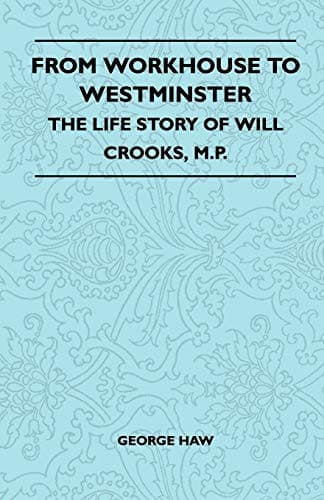
From Workhouse to Westminster: The Life Story of Will Crooks, M.P.Haw, George
History
From Workhouse to Westminster: The Life Story of Will Crooks, M.P.
Haw, George
Crooks, William, 1852-1921; Legislators -- Great Britain -- Biography; Social reformers -- Great Britain -- Biography
"If _Vanity Fair_ will train the rich, the Labour men will guide the
poor," he wrote. Further: "Old England is as dear to the Labour man with
poverty for his birthright as to the hereditary legislator with a county
for a heritage. But wealth, and the carelessness that wealth often
induces, are blind to the causes which heap misery and discontent upon
the people from generation to generation. To the wealthy the whole
business is a social phenomenon, but to us it is a permanent terror.
"And so, whatever our differences may appear to be, our Labour hopes are
concentrating upon sound practical methods by which the conditions and
opportunities of the people shall be improved.
"You who read this are invited to remember that organised work is the
first step which will separate the workman from demoralising charity,
his wife from the pawnshop, and his children from the streets. Sentiment
and sympathy need no longer be the prey of the fawning cadger, or the
victim of hypocritical distress.
"To keep England in the forefront of the nations of the earth we must
begin in the homes of our people, there to raise a truly Imperial and
patriotic race of good, healthy, honest men and women. The task is
admittedly a difficult one, for social reconstruction is as much moral
as economic, but helping hands stretch out in every direction. The one
great need is to change a national apathy into keen, sympathetic,
well-balanced criticism."
His agitation for the unemployed in the House of Commons, which formed
the main part of his parliamentary life for a couple of years, began
with the opening of the Session of 1904. He seconded Mr. Keir Hardie's
amendment to the Address, regretting, "in view of distress arising from
lack of employment," that no proposal was made for helping out-of-work
men.
Crooks began his speech by declaring that mere relief schemes encouraged
the loafer. He knew well both the loafer and the man who was born tired.
The wife of one such got up early and wakened her husband in time for
work.
"Is it raining?" the man asked from the folds of the bedclothes.
"No."
"Does it look like raining?"
"No."
"Oh, I wish it was Sunday."
Public-domain text, read in full here on John Shaqi.
Reviews
Reviews
No reviews yet
Be the first to share your thoughts on this work.
Elsewhere in the archive
Join the Discussion
Join the discussion
Sign in to leave a comment or review.
Sign InorCreate an account