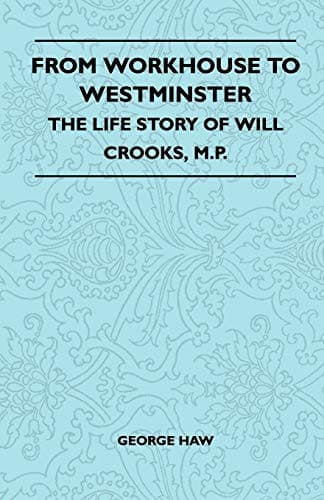
From Workhouse to Westminster: The Life Story of Will Crooks, M.P.Haw, George
History
From Workhouse to Westminster: The Life Story of Will Crooks, M.P.
Haw, George
Crooks, William, 1852-1921; Legislators -- Great Britain -- Biography; Social reformers -- Great Britain -- Biography
With a sudden change of tone and manner, Crooks then went on to tell the
House that if an able-bodied man out of a job was driven into the
workhouse, he generally remained a workhouse inmate for the rest of his
life. It degraded and demoralised him. It took away his muscle to stand
up and fight for himself. If the Local Government Board would permit
Guardians to take land, this man could be put to useful work. Even
able-bodied men of the "in-and-out" type would be better for being put
to work on the land under powers of compulsory detention. Of course,
these men should be allowed to go out if they really desired to look for
other work. What they should not be allowed to do was to drag their
wives and children about the country, vagrants bringing up more
vagrants. Employment on farm colonies would quickly get rid of the tramp
difficulty. Such men, trained in useful agricultural work, if they felt
they had little chance in this country, would then have some equipment
for the colonies. A country like Canada, for instance, had no use for
men who had simply been loafing about English towns, but would very
quickly find work for men who had had a little training and discipline
on the land. It would be better for the whole community that something
of this sort should be done than that we should go on with the present
system of doles and relief, whose effects, like idleness, only
demoralised.
The appeal to the House on that occasion fell on deaf ears.
The winter of 1904 was made memorable to him by the creation of the
Central Unemployed Committee. For several years he had urged that the
Poor Law Unions of London should be empowered to form a central
committee to deal with the unemployed on well-organised lines. With the
several Unions acting separately, confusion and waste followed on
well-meaning efforts. The genuine unemployed received little real help.
Few public men took his scheme for a central organisation seriously at
first. He was well-nigh worn out with his failures when unexpectedly the
then President of the Local Government Board came to his aid. Crooks,
with several other Members of Parliament, had waited upon Mr. Long in
deputation. The result was the calling together of the famous Unemployed
Conference at the Local Government Board on October 14th, 1904.
To that Conference the Poplar Guardians sent Crooks and Lansbury, armed
with a series of carefully-thought-out proposals. Some of them found a
ready acceptance on the part of Mr. Long. Others were adopted by the
succeeding Government.
Since those Poplar proposals have already figured prominently in
unemployed schemes and promise to appear in projects yet to be framed,
the substance of them is here set out:--
1. The President of the Local Government Board to combine the
London Unions for the purpose of dealing with the unemployed and
the unemployable.
2. Such central authority to take over the control of all
able-bodied inmates in London workhouses.
Public-domain text, read in full here on John Shaqi.
Reviews
Reviews
No reviews yet
Be the first to share your thoughts on this work.
Elsewhere in the archive
Join the Discussion
Join the discussion
Sign in to leave a comment or review.
Sign InorCreate an account