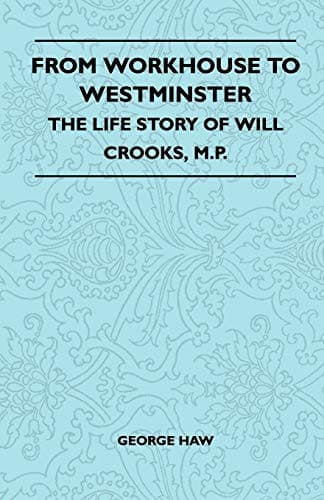
From Workhouse to Westminster: The Life Story of Will Crooks, M.P.Haw, George
History
From Workhouse to Westminster: The Life Story of Will Crooks, M.P.
Haw, George
Crooks, William, 1852-1921; Legislators -- Great Britain -- Biography; Social reformers -- Great Britain -- Biography
The lad was ravenously hungry all the time he spent in the workhouse. He
often felt at times as though he could eat leather; yet every morning,
when the "skilly" was served for breakfast, he could not touch it.
Morning after morning, spurred on by hunger, he forced the spoon into
his mouth, but the stomach revolted, and he always felt as though the
first spoonful would turn him sick.
Somehow his father, away in the men's ward, got to know that young Will,
who he knew could relish dry crusts at home with the best of them, was
not able to eat the fare provided in the workhouse. The men occasionally
got suet pudding, and one dinner-time the old man secretly smuggled his
portion into his pocket. In the afternoon he made over to the children's
quarters, hoping to hand it to Will. The pudding was produced, the lad's
hungry eyes lighted up, when, behold! it was snatched away, almost from
his very grasp. The burly figure of the labour master interposed between
father and son. This was a breach of discipline not to be tolerated in
the workhouse.
"But the boy's hungry, and this is what I've saved from my own dinner,"
argued the father (all in vain). "You don't know how that boy likes
suet pudding."
For two or three weeks the Crooks children were kept in the workhouse,
before being taken away in an omnibus with other boys and girls to the
Poor Law School at Sutton. Then came the most agonising experience of
all to Will. They parted him from his young brother. In the great hall
of the school he would strain his eyes, hoping to get a glimpse of the
lone little fellow among the other lads, but he never set eyes on him
again until the afternoon they went home together.
"Every day I spent in that school is burnt into my soul," he has often
declared since.
He could not sleep at night nor play with the other boys, haunted as he
was by the strange dread that he must have committed some unknown crime
to be taken from home, torn from his young brother, and made a little
captive in what seemed a fearful prison. The nights seemed endless, and
were always awful. He whispered his fears on the fourth day to another
Poplar boy who was there.
"Ah! you just wait until Sunday," said the other lad. "Every Sunday's
like a fortnight."
When Sunday did come it proved to be one lasting agony. He thought time
could not be made more terrible to children anywhere. They had dinner at
twelve and tea at six, confined during the yawning interval in the dull
day-room with nothing to do but to look at the clock, and then out of
the window, and then back at the clock again.
During the week, after school hours, he hung about in abject misery all
the time. From the day he went in to the day he left he never smiled.
One afternoon he was loitering in the playground as the matron showed
some visitors round.
"Who is that sad-faced boy?" he heard one of them ask.
"Oh, he's one of the new-comers," the matron answered. "He'll soon get
over it."
Public-domain text, read in full here on John Shaqi.
Reviews
Reviews
No reviews yet
Be the first to share your thoughts on this work.
Join the Discussion
Join the discussion
Sign in to leave a comment or review.
Sign InorCreate an account