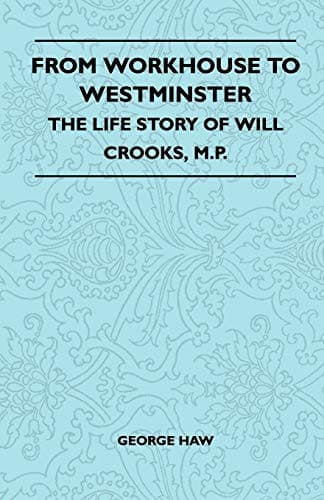
From Workhouse to Westminster: The Life Story of Will Crooks, M.P.Haw, George
History
From Workhouse to Westminster: The Life Story of Will Crooks, M.P.
Haw, George
Crooks, William, 1852-1921; Legislators -- Great Britain -- Biography; Social reformers -- Great Britain -- Biography
As soon as he was able to get out again in the New Year (1905), he took
up the case for the unemployed, if not with all his former zeal,
certainly with all the zeal he could then command.
Towards the end of January he had so far recovered as to be able to
attend the Liverpool Conference of the Labour Representation Committee.
He was then in a position to make public for the first time that the
King's Speech at the opening of Parliament in the following month would
in all likelihood promise an Unemployed Bill. On his motion the
Conference decided:
That the policy of the Labour Party in Parliament relating to
unemployment should be to secure fuller powers for the local
authorities to acquire and use land, to re-organise the local
administrative machinery for dealing with poverty and unemployment,
to bring pressure on the Government to put the recommendations of
the Afforestation Committee into effect, to undertake forthwith,
through the Board of Trade, the reclamation of foreshores, and to
create a Labour Ministry.
His forecast of the King's Speech proved correct. An Unemployed Bill was
promised. It was introduced on April 18th by Mr. Gerald Balfour, who had
succeeded Mr. Long at the Local Government Board. The Bill confirmed Mr.
Long's scheme of Distress Committees in London, and provided for the
formation of similar bodies in provincial towns. It granted the
principle of State aid by permitting the cost of organisation, including
the provision of farm colonies, to be charged to the rates, leaving it
to voluntary subscriptions to provide a fund for paying the men's wages.
That Session was made memorable to Crooks in another sense. A Royal
Commission on the Poor Law was appointed, and although it was little
faith he had in Commissions generally, he believed that, whatever came
of the recommendations of this one, it would help the people of England
to see, while its investigations were going on, something of the cruelty
and folly of a system which had been ruthlessly thrust upon the voteless
labouring people by the middle class individualists who came into power
after the Reform Act of 1832. His fellow Guardian, George Lansbury, was
appointed a member of the Commission--a notable compliment to Poplar,
which for a dozen years had striven to make this soulless system humane
and helpful.
Although the Unemployed Bill passed second reading with a majority of
217, the Session dragged wearily on with little prospect of its getting
through the Committee stage and becoming law. When August dawned and the
House found itself within a week of adjournment, everyone but Crooks
despaired of getting the measure through. The Prime Minister told the
House there was no time for the Bill. Several of Crooks's Labour
colleagues declared the Bill to be too meagre a thing to fight for.
Public-domain text, read in full here on John Shaqi.
Reviews
Reviews
No reviews yet
Be the first to share your thoughts on this work.
Elsewhere in the archive
Join the Discussion
Join the discussion
Sign in to leave a comment or review.
Sign InorCreate an account