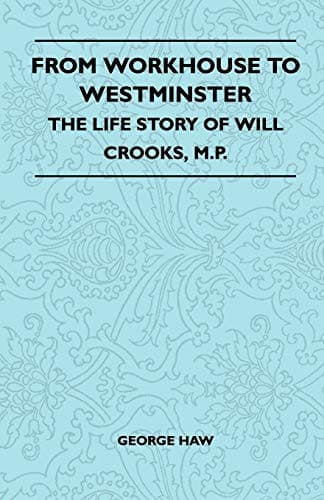
From Workhouse to Westminster: The Life Story of Will Crooks, M.P.Haw, George
History
From Workhouse to Westminster: The Life Story of Will Crooks, M.P.
Haw, George
Crooks, William, 1852-1921; Legislators -- Great Britain -- Biography; Social reformers -- Great Britain -- Biography
In his final speech on the Bill, Crooks argued that even the loafer
would become a better man by being given, not the charity that
demoralised, but a day's work for a day's pay. Such a man, by being put
on a farm colony for a few months, would be turned into a good citizen.
He stood for discipline in Labour as the Government stood for discipline
in the Army and Navy. He wanted to preserve the manhood of the nation
rather than to see it degraded, as it was by the present system of
despising an unemployed man. The type of men who hung idle about all our
large towns was the type that filled the workhouses and prisons. Take
them in their early stages of unemployment, put them under proper
discipline on the land, and he was prepared to prophesy they would
become useful citizens. It was a loss to the nation that men and women
should be going about without the common necessaries owing to being out
of work.
So the Bill went through, and people of all classes agree with his old
friend, Mr. A. F. Hills, a large employer, who wrote to him a letter on
the subject, ending with the words: "I believe that generations yet
unborn will in the years to come rise up and call you blessed."
In the opinion of many people well able to gauge the distress and
discontent of the country, the Act came just in time to prevent serious
disorders in the large towns. For the winter that immediately followed
found the unemployed in a worse plight than ever.
Promptly the Distress Committees formed under the Act got to work. The
London Committees found themselves at first stranded for funds. The weak
point in the Act was that which allowed only the expense of organisation
to be made a public charge. The Committees found themselves asking, What
was the use of organising work for the unemployed when there were no
means of paying wages? It looked as though public subscriptions were not
to be forthcoming. Was the Act, so hardly won, to fail on its first
trial?
Again Poplar fought the cause of the poor for the whole country. This
time the workless men's wives took action. The women of Poplar met in
the Town Hall, Mrs. Crooks in the chair, with the object of urging
Parliament to vote money to the Distress Committees set up under the new
Act.
Mrs. Crooks, as reported in the _Times_, said:
Public-domain text, read in full here on John Shaqi.
Reviews
Reviews
No reviews yet
Be the first to share your thoughts on this work.
Elsewhere in the archive
Join the Discussion
Join the discussion
Sign in to leave a comment or review.
Sign InorCreate an account