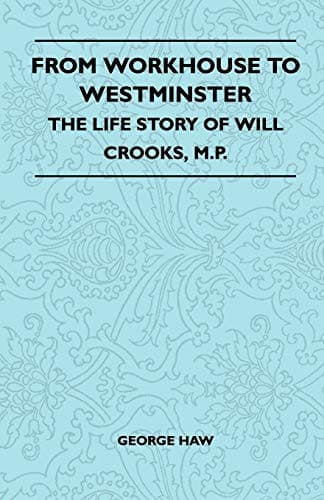
From Workhouse to Westminster: The Life Story of Will Crooks, M.P.Haw, George
History
From Workhouse to Westminster: The Life Story of Will Crooks, M.P.
Haw, George
Crooks, William, 1852-1921; Legislators -- Great Britain -- Biography; Social reformers -- Great Britain -- Biography
Gone are the old houses now, with the old traditions, the old gaiety,
the old mad enthusiasm for the sea. In his day the Blackwall seaman was
a dare-devil, efficient man, eagerly coveted by shipowners and captains
alike. Never did a ship sail from Blackwall during Crooks's schooldays
without most of the boys staying away from school, regardless of results
to their skins the next morning, in order to join in the farewell
cheering from the foreshore. The welcome home to the Blackwall ships was
something to remember. It was always a bitter disappointment to the
boys, since it robbed them of an opportunity of playing truant, if a
ship came home and docked during the night, having come up, as the old
tide-master used to say, and brought her own news.
Little remains to suggest the sea in Poplar High Street to-day. The old
highway has lost its old glory. The old folks have forsaken the old
homesteads. Of the few old buildings that remain, nearly every one has
been cut up into small shops and tenements. One or two general dealers
still pose as ships' outfitters, and an occasional shop remains as a
marine store, as though in a final feeble struggle to preserve the old
traditions.
Crooks recollected well the period that costermongers thronged this
riverside highway. They came about the time seamen were deserting it, so
that the street for some time lost nothing of its noise or bustle. The
day came when they, too, departed, seeking a more profitable field in
Chrisp Street, on the northern side of East India Dock Road, where to
this day they still hold carnival. That they carried away something of
the seafaring character of their former highway is borne out by the
nautical turn they give to some of their remarks.
"Here," cried a fish-dealer of their number the other day, holding aloft
a haddock, "wot price this 'ere 'addick?"
"Tuppence," suggested a woman bystander.
"Wot! tuppence! 'Ow would you like to get a ship, an' go out to sea an'
fish for 'addicks to sell for tuppence in foggy weather like this?"
As we passed down that portion of the High Street that skirts the
Recreation Ground, Crooks pointed out the quaint old church of St.
Matthias. He told me it was the oldest church in Poplar, built as a
chapel-of-ease to the mother church of East London, St. Dunstan's. Then
it was that all the parishes that now go to make up the teeming Tower
Hamlets were comprised in Stepney. As the Port of London in those days
was confined to the Pool and lower reaches and to the riverside hamlets
of the East End, that was why people born at sea were often entered as
having been born in the parish of Stepney.
Public-domain text, read in full here on John Shaqi.
Reviews
Reviews
No reviews yet
Be the first to share your thoughts on this work.
Join the Discussion
Join the discussion
Sign in to leave a comment or review.
Sign InorCreate an account