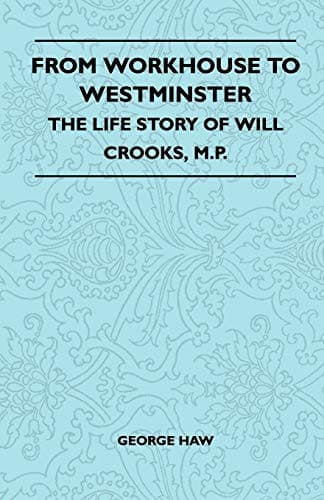
From Workhouse to Westminster: The Life Story of Will Crooks, M.P. — John Shaqi
From Workhouse to Westminster: The Life Story of Will Crooks, M.P.Haw, George
History
From Workhouse to Westminster: The Life Story of Will Crooks, M.P.
Haw, George
Crooks, William, 1852-1921; Legislators -- Great Britain -- Biography; Social reformers -- Great Britain -- Biography
"I don't think you would, Jack," Crooks replied, preparing to take off
his coat.
Then the carman understood.
In his third year at the smithy Will was getting six shillings a week,
with something more than a penny an hour for overtime. Small though the
wages were, they were very welcome at home; and it meant a great deal
to his mother when she sacrificed more than half this amount in the
lad's best interest.
She was as determined that her boys should learn a trade as that they
should learn to read and write. She took Will away from the smithy and
his six shillings a week, when she found he was not to be taught the
business but to be merely a smiths' labourer, and she apprenticed him to
the trade of cooper at a weekly wage of half a crown.
"The sacrifice of a few shillings a week," says Crooks, "which mother
made in order that I should learn a trade was only one of the many
things she did for me as a boy for which I have blessed her memory in
manhood many times. I really don't know now how she managed to feed us
all, after losing my three-and-six a week. I know that she always put up
a good dinner in a handkerchief for me to take to work. It may have got
smaller towards the end of the week, like many of the men's. I remember
one Monday dinner-time flopping down on a saw-tub and opening my
handkerchief as the foreman passed.
"'That looks a good meal to begin the week on,' he said. 'I see how it
is;--
It's Monday plenty,
Tuesday some,
Wednesday a little,
Thursday none,
Don't worry about Friday,
You get your money on Saturday.'"
Among the workmen was a thinker and reformer far ahead of his times. It
was dangerous in those days for workmen to give expression to advanced
views, and as he was a married man he made no display of his opinions.
He seems to have seen promise in young Will, for he talked to him freely
on social and political matters, encouraging him to read by lending him
books and papers, and inspiring him with an enthusiasm for the teaching
of John Bright.
So much so, that at home Will was nicknamed Young John Bright. An uncle,
looking in on the eve of the General Election of 1868, said jokingly,
"Now, young John Bright, tell us all about what is going to happen."
Nothing loath, Will delivered a long speech on the political situation,
and foretold, among other things, that the Liberals would sweep the
country, and that one of their first acts would be to disestablish the
Church of Ireland. The prophecy, needless to say, was fulfilled.
Will was one of half-a-dozen apprentices in the coopering establishment.
While still the youngest among them he made his mark by acting as
spokesman in a sudden emergency. The lads thought they had a grievance
under the piece-rate system. They went in a body to the head of the
firm, the eldest primed with a well-rehearsed speech stating their case.
Public-domain text, read in full here on John Shaqi.
Reviews
Reviews
No reviews yet
Be the first to share your thoughts on this work.
Join the Discussion
Join the discussion
Sign in to leave a comment or review.
Sign InorCreate an account