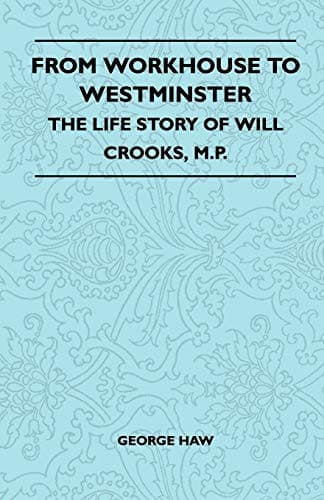
From Workhouse to Westminster: The Life Story of Will Crooks, M.P.Haw, George
History
From Workhouse to Westminster: The Life Story of Will Crooks, M.P.
Haw, George
Crooks, William, 1852-1921; Legislators -- Great Britain -- Biography; Social reformers -- Great Britain -- Biography
Everybody sprang forward to snatch his garments from the fire. One
rescued his coat, another his vest, another his cap, another his
muffler, another his pair of boots, the old man belabouring each in
turn.
"Ah!" he cried with a chuckle, as the singed garments were dragged away.
"I knew that would find you all out."
Quaint and boisterous customs were observed when an apprentice was out
of his time. The greater part of the day was given up by men and boys
alike to revelry and horse-play.
The ceremonies began at about eleven o'clock in the morning, to be kept
up for the rest of the day. First, the apprentice was seized and put
into a hot barrel. Round him stood some fifty men and boys checking
every attempt he made to get out, tapping him with hammers on the head
and fingers and shoulders every time he made an effort to escape. When
his clothes--the last he was to wear as an apprentice--had been singed
in the barrel out of all further use, he would be dragged out and tossed
in the air by about a dozen of the strongest men.
Only once did the employer try to stop these boisterous interludes. He
never tried again. The men laid hold of him, and for about five minutes
treated him to a vigorous tossing.
It then became the bruised and singed apprentice's privilege to pay for
bread and cheese and drink. In the afternoon the men turned the yard
into an imitation fair. Flags and bunting were put up and side shows
were improvised. One feature was to persuade the fattest men to walk the
tight-rope.
On the whole, Will had a happy time as an apprentice, working hard and
laughing hard, more than once threatened with dismissal because his
spirit of fun led him into mischief. He became a good craftsman, and to
this day boasts of being as skilful at his own trade as any man. He
attributes this to the old spirit of craftsmanship that held good in his
day. One incident during his apprenticeship helped to make him take a
pride in what he made with his own hands. An old workman in the shop,
after finishing a piece of work, set it in the middle of the floor and
walked round it admiringly several times.
"'Pon my honour, one would think you'd made a thousand-horse-power
engine," said the apprentice.
"Never you mind, sonny," replied the old workman. "Whether it's a
thousand-horse-power engine or not, _I made it myself_!"
"That is the spirit I want to see revived among workmen to-day," Crooks
told the Labour Co-partnership Association in 1905, relating the
incident at their annual exhibition at the Crystal Palace. He went on to
say:
Public-domain text, read in full here on John Shaqi.
Reviews
Reviews
No reviews yet
Be the first to share your thoughts on this work.
Join the Discussion
Join the discussion
Sign in to leave a comment or review.
Sign InorCreate an account