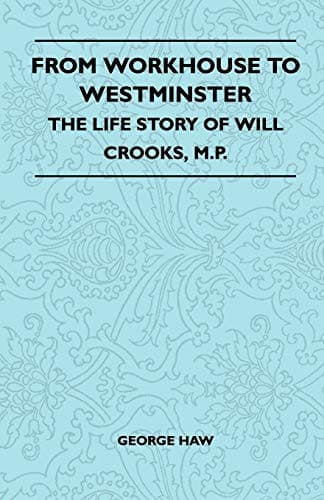
From Workhouse to Westminster: The Life Story of Will Crooks, M.P. — John Shaqi
From Workhouse to Westminster: The Life Story of Will Crooks, M.P.Haw, George
History
From Workhouse to Westminster: The Life Story of Will Crooks, M.P.
Haw, George
Crooks, William, 1852-1921; Legislators -- Great Britain -- Biography; Social reformers -- Great Britain -- Biography
They set up their home in Poplar, near the coopering yard where Will was
employed. At first they had to be content with apartments; then came a
small tenement; soon after a little house of their own.
It was fair and pleasant sailing for the first two or three years. He
got a journeyman's full wages the first week he was out of his
apprenticeship. It seemed as though he were to have an unbroken run of
good fortune. The bright hopes soon collapsed.
Good craftsmanship and trade unionism, blended as they were in Crooks,
made him rebel against certain conditions of his work. Finally he
refused to use inferior timber on a job, and objected to excessive
overtime. Although the youngest among them, he addressed the workmen on
the subject. A few days afterwards he was dismissed.
He took his notice lightly enough, confident that as master of his trade
he could soon secure work again.
It was not to be. Every shop and yard in London was closed to him. Word
had gone round that he was an agitator.
Try as he did, he could not break through the barrier that had been
raised against him. Wherever he applied, whether in Rotherhithe,
Battersea, Hackney, or Clerkenwell, he was known as the young fellow who
would not work with shoddy material and talked other men into the same
view.
The experience was the same at every place of call.
"What's your name?"
"Crooks."
"Of Poplar?"
"That's me."
"We don't want anyone."
From several of these places he heard afterwards that the instant he was
gone other men were taken on.
Since London was a closed door to him, he turned his back upon it, and
set out tramping the country in search of work. With a fully-paid-up
trade union card, he knew he could count on an occasional half-crown to
help him on the way at those towns where his society had branches.
His home had to be broken up. His wife with their child went to her
mother's, there to await for weary weeks the result of her husband's
first quest into the country.
The only piece of good news came from Liverpool. Not until he reached
that city did he get a job. He tramped into Liverpool from
Burton-on-Trent. Never in his life, either before or since, did a silver
coin mean so much to him as the half-crown given by a member of his own
trade to help him on the road as he set out from Burton for Liverpool.
Twenty-nine years later Crooks was speaking at a meeting of co-operators
in Burton when he recognised his former benefactor on the platform. He
told the audience of his last visit to their town, remarking how on that
occasion no one but this man offered him hospitality, whereas now, if he
lived to be a hundred and fifty years of age, he would not be able to
accept all the invitations he had received from friends and would-be
friends to spend week-ends with them. His regret was, he told the
meeting, that those good people did not begin to ask him earlier and
that they did not think of asking other poor men in a similar plight to
his when he first entered Burton.
Public-domain text, read in full here on John Shaqi.
Reviews
Reviews
No reviews yet
Be the first to share your thoughts on this work.
Join the Discussion
Join the discussion
Sign in to leave a comment or review.
Sign InorCreate an account