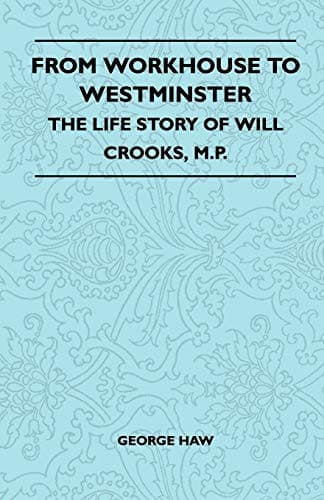
From Workhouse to Westminster: The Life Story of Will Crooks, M.P. — John Shaqi
From Workhouse to Westminster: The Life Story of Will Crooks, M.P.Haw, George
History
From Workhouse to Westminster: The Life Story of Will Crooks, M.P.
Haw, George
Crooks, William, 1852-1921; Legislators -- Great Britain -- Biography; Social reformers -- Great Britain -- Biography
Commending himself to his Employers--"Crooks's College"--His Style
of Teaching--Specimens of his Humour--Admonitions against Drink and
Betting.
With regular work well assured, Crooks was able to give more time and
study to public affairs and to the Labour Movement. For an unbroken
period of ten years he held a good position in a large coopering
establishment in East London, where he was held in high esteem by men
and masters alike, the latter more than once intimating to him they
would make it worth his while to remain in their service all his life.
Crooks was always proud of the good standing he held in his employers'
eyes. He knew it was due solely to his skill as a workman, for it
certainly did not tell in his favour that he was beginning to be known
more widely than ever as a Labour agitator. This, as a term of derision,
used to be applied to all Labour leaders in the 'eighties and long
afterwards. Certain writers and speakers who wished to be particularly
derisive would refer to them as paid agitators. Even to this day an
occasional echo of the cry reaches the ears. The offenders belong to the
same school as the lady who withdrew her money from the bank after the
General Election of 1906 because so many Labour members had been
returned.
It was during these years of regular work that Crooks founded his famous
College. He began a series of Sunday morning Labour meetings outside the
East India Dock Gates, which have been continued ever since. The place
in association with these Sunday meetings came to be known among Poplar
workmen as Crooks's College.
Many a useful lesson has he driven home to his working class audiences
at his College at the Dock Gates. He generally leads off with some
little humorous fancy.
"If you fellows only have a quid a week, don't despise your share in the
country's government. You needn't go the length of the Cockney taxpayer
who rowed out to a man-o'-war at Portsmouth.
"'Ship ahoy!' he shouts. 'Ship ahoy!'
"At last he makes someone hear.
"'Is the captain aboard?' says he.
"'What d'yer want with the captain?' asks a bluejacket.
"'Feller,' says the taxpayer, big-like, 'just tell your captain that one
of the owners of this 'ere ship wants to come aboard, and look slippy
about it.'
"The captain invites him on the deck, and he goes round the ship
sniffing at this and complaining about that until the ship's carpenter
gets riled.
"'Don't you know that I have a share in this ship, feller?' says the
taxpayer.
"'Oh, have yer?' says the carpenter, handing him a chip. 'You just take
your share then, and get over the side double quick, or I shall be under
the necessity of showing you the way.'"
When the East End was suffering from one of the water famines that used
to be fairly common before the supply was taken over by a public
authority, he never tired of calling the attention of his Dock Gate
meetings to the fact that the company went on charging the same rates,
whether there was water or not.
Public-domain text, read in full here on John Shaqi.
Reviews
Reviews
No reviews yet
Be the first to share your thoughts on this work.
Join the Discussion
Join the discussion
Sign in to leave a comment or review.
Sign InorCreate an account