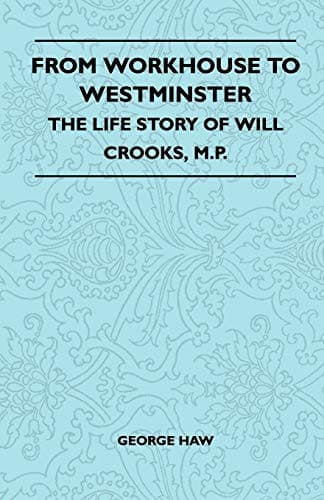
From Workhouse to Westminster: The Life Story of Will Crooks, M.P.Haw, George
History
From Workhouse to Westminster: The Life Story of Will Crooks, M.P.
Haw, George
Crooks, William, 1852-1921; Legislators -- Great Britain -- Biography; Social reformers -- Great Britain -- Biography
The post offered him carried with it a salary of £500. He had six
children to bring up. There was the uncertainty as to the Labour League
being able to keep up the Wages Fund. He pondered over the matter
carefully. His decision changed the current of his life. A manager, no
matter how sympathetic, could not have remained long in the Labour
Movement. Besides, in this case there were hints of a future
partnership. Then it was that he decided calmly and deliberately to give
his life not to money-making, but to the service of the people. He
deliberately chose to remain a poor man in the service of poor men.
Having been made to bear so much of the care of this world, he
determined that he would know nothing of the deceitfulness of riches.
Nothing has ever shaken him from that decision. From various quarters
since then other good offers have come his way. One of them, a
Government post, must be regarded as a singular tribute to his worth,
since the offer came from a Conservative Cabinet Minister.
The manager of a large firm engaged in carrying out public works to the
value of over a million sterling, gave me at the time a frank opinion of
Crooks from the employers' standpoint.
"I can't help liking that chap Crooks. But it's a pity he's on what I
call the wrong side. He's been negotiating with our firm until he has
compelled us to pay our men several thousand pounds a year extra in
wages. And a lot of thanks they give him for it! I overhear them
sometimes talking at work. They say he wouldn't have got them more money
if he hadn't been getting something out of it himself. Now if Crooks
would only place his ability on the employers' side he could earn a
thousand a year easily."
For ten years after he entered public life Crooks was content with the
same five-roomed house in Northumberland Street where the deputation of
working men found him when they came to invite him to stand for the
County Council. When he did move it was into a neighbouring street,
Gough Street, where the upgrown family had the advantage of an
additional room. That remains his home to this day.
One of his ardent admirers in Poplar, a well-to-do man, on learning he
was moving from Northumberland Street, offered him a house of his own
rent free. It was a large and pleasant house in East India Dock Road,
boasting a garden front and back. The owner implored him to take it for
the rest of his life, "as a small tribute from one who appreciates the
splendid public services you have rendered to Poplar."
"It would never do for me to live in such a house," was Crooks's reply
in thanking the well-wisher. "My friends among the working people would
fear I was deserting their class, and would not come to me as freely as
they come now. My enemies would say, 'Look at that fellow Crooks; he's
making his pile out of us.' A Labour man like me must leave no opening
for his enemies."
Public-domain text, read in full here on John Shaqi.
Reviews
Reviews
No reviews yet
Be the first to share your thoughts on this work.
Join the Discussion
Join the discussion
Sign in to leave a comment or review.
Sign InorCreate an account