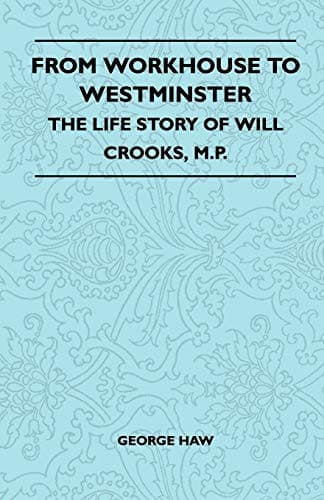
From Workhouse to Westminster: The Life Story of Will Crooks, M.P.Haw, George
History
From Workhouse to Westminster: The Life Story of Will Crooks, M.P.
Haw, George
Crooks, William, 1852-1921; Legislators -- Great Britain -- Biography; Social reformers -- Great Britain -- Biography
This only goes to show how closely Mr. Crooks himself has been
identified with the construction of the tunnel. As one of the
representatives of the Poplar district, he has turned his
membership of the Bridges Committee to good account by giving to
the tunnel his special attention. No Councillor has been so
frequent a visitor to the various works, and it is doubtful
whether any outsider went so many times into the compressed air.
The workmen had just cause to bless the Poplar County Councillor.
It was owing to Mr. Crooks's efforts that a revised schedule of
wages was adopted. The result of this was that the contractors paid
an additional £26,000 in wages. With all his zeal for the workmen,
Mr. Crooks never once came in conflict with either the contractors
or the engineers. Men and masters at Blackwall have all held the
worthy Labour Councillor in the highest regard, and both are sorry
that their long and cheerful connection must now be severed.
The same number of the _Municipal Journal_ contained an article by
Crooks himself, entitled, "A Labour View of the Blackwall Tunnel." The
article displayed with what tact and modesty the Labour member had
safeguarded the interests of his own class without neglecting the
interests of the people of London. It bore out the statement made in his
first speech to the Council, that no contractor ever lost by paying the
trade union rate of wages.
CHAPTER XIII
THE TASK OF HIS LIFE BEGINS
Elected to the Poplar Board of Guardians--Bumbledom in
Power--Prison preferred to Workhouse--Poverty treated like Crime.
Six months after his return to the London County Council, Poplar elected
Crooks to the Board of Guardians. When he took his seat as a member in
the very Board-room where thirty years before he clung timorously to his
mother's skirt he knew that the task of his life had begun.
He and his friend George Lansbury were elected together--the only Labour
men on a Board of twenty-four. They were the firstfruits of the reduced
qualification for Guardians introduced by Mr. (afterwards Lord) Ritchie,
at that time President of the Local Government Board.
To Crooks belongs much of the credit for this welcome change. He felt
keenly that working-men and women could never become Guardians of the
Poor so long as the £40 property qualification remained. He persuaded
the Poplar Trustees, of whom he was one, to ask the Local Government
Board to make it possible for workpeople to become Guardians. Mr.
Ritchie, ever sympathetic towards the East-End, a division of which he
was then representing in Parliament, met this request from Poplar by
lowering the qualification to £10. His successor at the Local Government
Board, Sir Henry Fowler, abolished the property qualification
altogether.
Public-domain text, read in full here on John Shaqi.
Reviews
Reviews
No reviews yet
Be the first to share your thoughts on this work.
Elsewhere in the archive
Join the Discussion
Join the discussion
Sign in to leave a comment or review.
Sign InorCreate an account