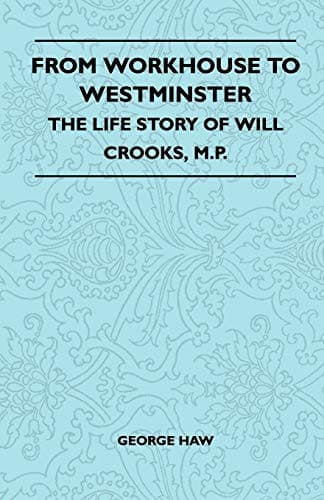
From Workhouse to Westminster: The Life Story of Will Crooks, M.P.Haw, George
History
From Workhouse to Westminster: The Life Story of Will Crooks, M.P.
Haw, George
Crooks, William, 1852-1921; Legislators -- Great Britain -- Biography; Social reformers -- Great Britain -- Biography
At the time of Crooks's election the dissatisfaction felt by ratepayers
with the old Guardians was deep and bitter. The Local Government Board
has evidence in its possession that poor people of the district were
saying at the time that if you wanted out-relief you must move into such
and such a street, where rents were collected by someone who had
influence with the Board.
Inside the workhouse Crooks found a state of things that seems
incredible to-day. Bumbledom held sway over paupers and Guardians alike.
There were Guardians who had never been inside the workhouse once. When
Crooks attempted to enter as a Guardian he found that the Master had
power to shut the gate upon him. Without the Master's permission, except
on the regular House Committee days, Guardians had no legal right inside
the workhouse at all.
The two Labour men raised such a hubbub over this anomaly that Sir Henry
Fowler issued an order giving a Guardian the right to enter the
workhouse at any reasonable hour. As a result there began, not only in
Poplar but all over the country, a marked improvement in the treatment
of old people in workhouses.
Here was a distinct score at the first venture. With the right of
admission established, Crooks made full use of it. He found most of the
officers hostile. So much so, that during a fire that broke out in the
workhouse bakery, bringing the brigade engines round, one of the
officers exclaimed, in the presence of the others when the fire was at
its height:--
"The only thing wanting now is that Crooks and Lansbury should be put on
the top of it."
The cheers with which this remark was received were soon to give way to
grave concern. It was clear the two Labour men meant to put an end to
many things. Several of the officers were summarily suspended by Crooks
one morning when he appeared on the scene unexpectedly.
A woman inmate had contrived to escape from the workhouse. She came
round to his house and knocked him up. In consequence of an alarming
story she told him respecting the conditions under which a fellow inmate
had died in her arms that very night, Crooks hurried round to the
institution and suspended certain of the officers on the spot.
The officers whom Crooks had suspended were dismissed by the Board. Nor
were they by any means the last to be dismissed or to take their
departure, for other scandals were brought to light.
"We found the condition of things in the House almost revolting," Crooks
stated in evidence before the Local Government Board Inquiry of 1906.
"The place was dirty. The stores were empty. The inmates had not
sufficient clothes, and many were without boots to their feet. The food
was so bad that the wash-tubs overflowed with what the poor people
could not eat. It was almost heart-breaking to go round the place and
hear the complaints and see the tears of the aged men and women.
"'Poverty's no crime, but here it's treated like crime,' they used to
say.
Public-domain text, read in full here on John Shaqi.
Reviews
Reviews
No reviews yet
Be the first to share your thoughts on this work.
Elsewhere in the archive
Join the Discussion
Join the discussion
Sign in to leave a comment or review.
Sign InorCreate an account