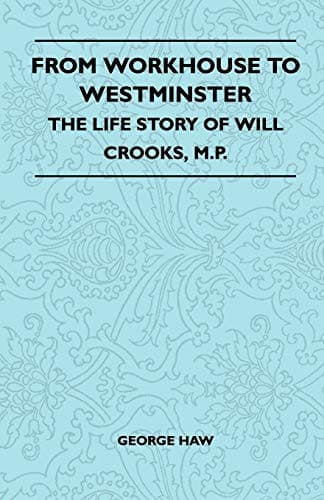
From Workhouse to Westminster: The Life Story of Will Crooks, M.P.Haw, George
History
From Workhouse to Westminster: The Life Story of Will Crooks, M.P.
Haw, George
Crooks, William, 1852-1921; Legislators -- Great Britain -- Biography; Social reformers -- Great Britain -- Biography
And then, for the benefit of the infirm old folk, Crooks persuaded the
Guardians to substitute butter for margarine, and fresh meat for the
cheap stale stuff so often supplied. He held out for milk that had not
been skimmed, and for tea and coffee that had not been adulterated. He
even risked his reputation by allowing the aged women to put sugar in
their tea themselves, and the old men to smoke an occasional pipe of
tobacco.
Rumours of this new way of feeding the workhouse poor reached the
austere Local Government Board. First it sent down its inspectors, and
then the President himself appeared in person. And Mr. Chaplin saw that
it was good, and told other Boards to do likewise. He issued a circular
to the Guardians of the country recommending all that Poplar had
introduced. More, he proposed that for deserving old people over
sixty-four years of age "the supply of tobacco, dry tea, and sugar be
made compulsory."
This humane order of things, you may be sure, did not commend itself to
all Guardian Boards; and when later there came further instructions from
headquarters that ailing inmates might be allowed "medical comforts,"
the revolt materialised. A deputation of Guardians went to Whitehall to
try to argue the President into a harder heart. Crooks and Lansbury were
there to uphold the new system. Mr. Walter Long had succeeded Mr.
Chaplin then. He listened patiently to ingenious speeches in which
honourable gentlemen tried to show that it was from no lack of love for
the poor they had not carried out the new dietary scale, but----
"Gentlemen," Mr. Long interrupted at last, "am I to understand you do
not desire to feed your poor people properly?"
Then all with one accord began to make excuse. It was the difficulty of
book-keeping, they said. It appeared they were prepared to stint the
poor rather than add to the book-keeping.
From that day an improved dietary scale was introduced into our
workhouses. The man who fed the poor in Poplar saw the workhouse poor of
the kingdom better fed in consequence.
What kind of food was it that Poplar dared to give to the poor? Those
"luxuries for paupers" down at Poplar, about which the world was to hear
so much, what were they? A working-man had appeared, and after years of
unwearied well-doing had got rid of "skilly" and "greasy water,"
substituting, with the approval of two Presidents of the Local
Government Board, the following simple articles of food.
Observe the list carefully, for the kinds and quantities of food here
set out were precisely those supplied to the able-bodied inmates during
the outcry that arose over "paupers' luxuries" at the time of the Local
Government Board Inquiry in 1906. The list is the official return of the
food supplied in one week to each inmate.
A MAN'S DIET FOR A WEEK.
(COST, 4s. 2d.)
Public-domain text, read in full here on John Shaqi.
Reviews
Reviews
No reviews yet
Be the first to share your thoughts on this work.
Elsewhere in the archive
Join the Discussion
Join the discussion
Sign in to leave a comment or review.
Sign InorCreate an account